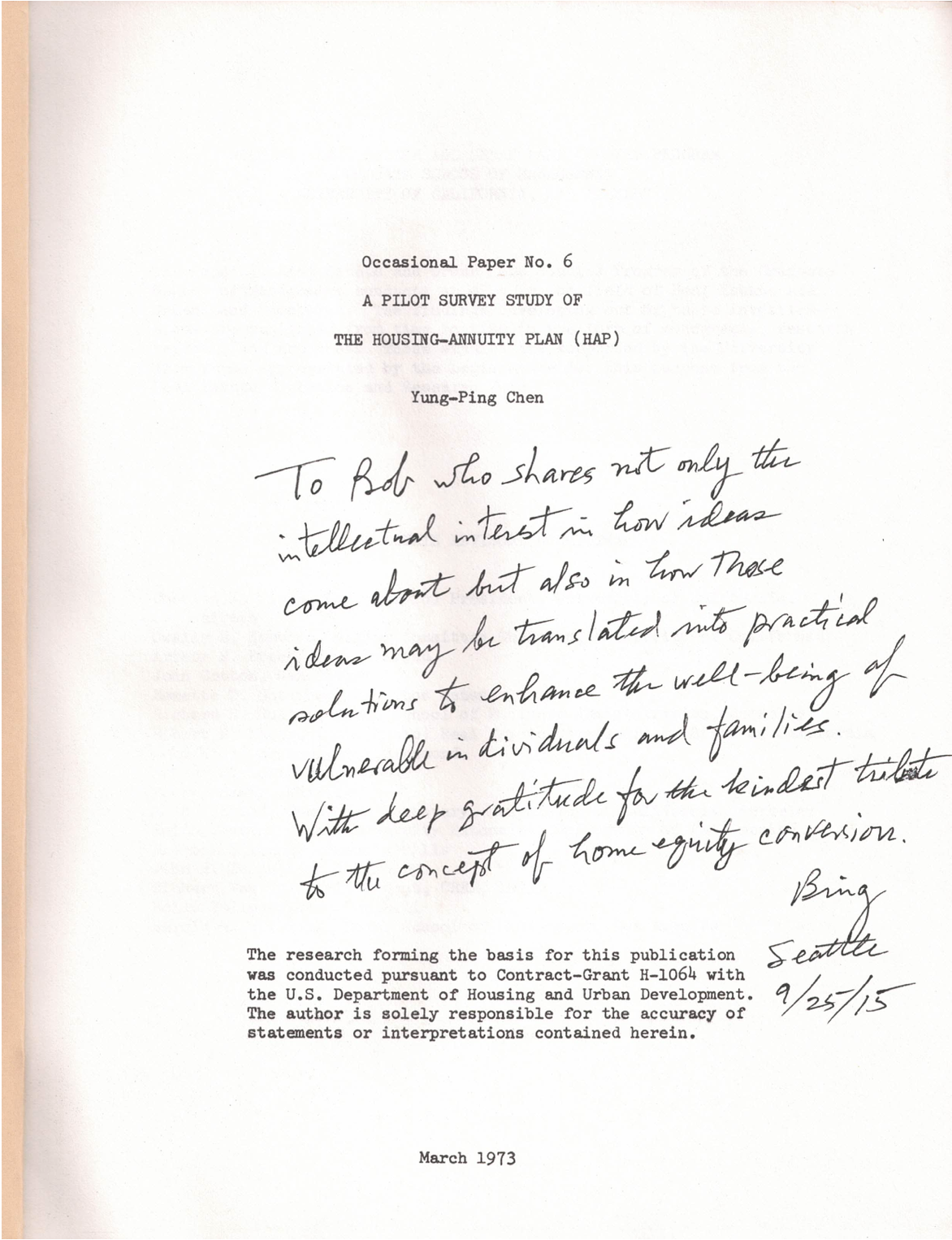
To really understand what the reverse mortgage was built for, you have to go back to the 1960s and a UCLA economist named Dr. Yung-Ping Chen. I had the chance to interview Dr. Chen a few years back, and what he told me about his original research reshaped how I think about home equity in retirement. He was generous enough to share a copy of his HUD-funded research with me — the study that carried his idea out of academic theory and into real public policy.
The Blind Spot in How We Measured Poverty
In the early 1960s, Dr. Chen was studying poverty among older Americans. Back then, poverty was measured almost entirely by cash flow: if a retiree’s Social Security check and pension fell under a certain line, they were labeled poor. Full stop.
Chen noticed a gap in that math.
A lot of older homeowners had thin monthly incomes but owned their homes outright, debt-free. On paper they looked broke. In reality, they were sitting on a substantial asset — they just had no way to turn it into usable cash without leaving the house.
Chen called this the “income poor but house rich” problem.
A Better Way to Define Wealth
His solution was to argue for a “net-worth approach” to financial well-being — one that counted assets, not just income.
If home equity could somehow be converted into spendable cash while the owner stayed put, Chen reasoned, a huge number of retirees would no longer look impoverished at all. Their wealth wasn’t gone; it was just frozen in the walls around them.
The obvious catch: selling the house to get at that equity defeated the whole purpose. People didn’t want to leave the homes where they’d raised families and built their lives.
That tension pushed Chen toward something new.
Born in a Senate Hearing: The Actuarial Mortgage Plan
In 1969, Chen brought his idea to Washington, testifying before the Senate Special Committee on Aging about what he called the Actuarial Mortgage Plan.
The goal, as he described it, was twofold: let older homeowners cash in the equity they’d spent decades building, and let them do it without having to move.
That hearing was the first real seed of what would eventually become the Home Equity Conversion Mortgage (HECM) — though it would take nearly two decades of work before Congress made it law.
It Was Never Just About the Loan
What stands out about Chen’s work is that he wasn’t thinking like a lender. He was making a philosophical argument: home equity is retirement wealth, full stop, and it shouldn’t be treated as separate from a person’s financial picture just because it’s illiquid.
His research pointed to something uncomfortable — a lot of “poor” retirees weren’t actually poor. Their biggest asset was simply invisible to the way we counted wealth. Give people a way to access that equity without selling, and you could improve their day-to-day finances while letting them stay exactly where they were.
From Idea to Law: A Twenty-Year Road
Getting from Chen’s testimony to an actual federal program took nearly twenty years. After his 1969 appearance before Congress, the idea moved through rounds of academic research, pilot programs, and policy debate. Economists, aging advocates, and housing groups kept refining the model, while lawmakers worked to balance retirement income needs against the risk of exploiting vulnerable homeowners.
That process finally landed with the Housing and Community Development Act of 1987, which created the HECM demonstration program. The first FHA-insured HECM closed in 1989 — a retirement tool two decades in the making, finally real.
The Original Idea Still Holds Up
Today, that original intent has been — and continues to be — the driving force behind the product. Most HECMs today are used to supplement older Americans’ retirement spending, letting them live more comfortably in the home they love.
The HECM has also grown well past its original use case. Today, financial planners use it in numerous ways. See my blog articleThe HECM Eight: Eight Powerful Ways a Reverse Mortgage Can Strengthen Your Retirement.
Every one of those strategies traces back to the same insight Chen had over sixty years ago: a home isn’t just shelter — for most retirees, it’s their single largest financial asset.
Used well, that equity can become a working part of a retirement income plan instead of sitting idle on paper. Chen’s core question from 1969 hasn’t gone anywhere: home equity clearly has value — so why should it stay off-limits just because it’s tied up in a house?