Skip to content

Who Created Reverse Mortgages in the US?

Some people have heard that a reverse mortgage is a scheme or a scam perpetrated on helpless seniors. Others may consider a reverse mortgage a welfare handout.

Many are surprised to learn that the 100th U.S. Congress initiated the modern reverse mortgage through the Housing and Community Development Act of 1987, which President Ronald Reagan signed in February 1988.

Congress tasked the Federal Housing Administration (FHA) with designing a reverse mortgage that would protect older homeowners while also encouraging lending in the private sector.

In December 1988, the Department of Housing and Urban Development (HUD) published a notice asking potential mortgage lenders to participate in a demonstration program that would “insure up to 2,500 reverse mortgages on the homes of elderly homeowners, enabling them to turn their equity into cash.”

Through the Home Equity Conversion Mortgage (HECM) Insurance Demonstration, the modern reverse mortgage was born.

How FHA Insurance Works

The FHA addressed the need to protect both the homeowner and the lender by modifying its existing mortgage insurance program to accommodate reverse mortgage lending. Understanding how the FHA operates in traditional lending provides a helpful comparison.

Created in 1934 as part of the National Housing Act, the FHA provides mortgage insurance on loans made by FHA-approved lenders throughout the United States and its territories. The FHA insures mortgages on single-family and multifamily homes, including manufactured homes and hospitals. In 1965, the FHA became part of HUD.

At the height of the Great Depression, Congress and President Franklin Roosevelt created an incentive for lenders to provide financing to certain higher-risk borrowers by protecting lenders against loss. FHA insurance premiums were assessed on these loans and used to fund that protection.

With traditional FHA loans, homeowners pay upfront and monthly insurance premiums. These premiums protect lenders against losses if a homeowner defaults. FHA lenders bear less risk because the FHA may pay a claim to the lender following a homeowner’s default.

To qualify for FHA insurance protection, loans must meet specific requirements established by the FHA.¹

Adapting FHA Insurance to Reverse Mortgages

Insurance is based on the participation of many people to cover the losses of a few. In other words, participants pool funds by paying premiums, transferring a portion of the risk to the insurance provider.

The HECM program adopted the FHA insurance concept but modified it to accommodate the needs of reverse mortgage lending:

Insurance premiums are not paid monthly. Instead, they are added to the loan balance.

The homeowner or the homeowner’s estate is released from liability if the loan balance exceeds the home’s value.

If the home’s value does not cover the loan balance, the lender is protected by FHA insurance.

The resulting HECM program, which includes FHA insurance, is designed to encourage lenders to provide loan proceeds while protecting them if circumstances do not unfold as anticipated.

The HECM also protects homeowners and their estates if the loan balance grows beyond the value of the home. Its consumer safeguards are substantial and have continued to evolve to protect both individual borrowers and taxpayers.

Unfortunately, these HECM consumer protections are sometimes overlooked by the financial press and by financial advisers upon whom many Americans rely for information about their retirement options.

Addressing Weaknesses in the Program

Despite HUD’s continued efforts to refine the program, weaknesses emerged over time.

During the housing bubble years, HECMs were sometimes used to address financial situations that were already unsustainable. Some borrowers did not take seriously the requirement to remain current on their property taxes and homeowners insurance.

In other cases, younger spouses who were not listed on the property title were displaced when the borrower died. Some borrowers also used the HECM irresponsibly by withdrawing their entire initial credit limit at closing, leaving no cushion if home values declined.

These were serious problems that jeopardized both the program and its reputation.

In response, the 113th Congress passed the Reverse Mortgage Stabilization Act of 2013. The law was enacted to provide additional protections for non-borrowing spouses and to help restore the financial health of the FHA Mutual Mortgage Insurance Fund.

The HECM program’s insurance pool was intended to be self-sustaining, not a taxpayer bailout. However, when the housing bubble collapsed, the fund’s solvency was placed in jeopardy. HUD responded by changing its lending standards, and the HECM program was significantly revised. As a result, the fund’s financial strength began to improve.²

Additional Consumer Protections

Financial assessments are now part of the HECM loan approval process.

To reduce the likelihood of property tax and homeowners insurance defaults, formulas are used to determine whether a portion of the borrower’s available equity must be set aside to cover these expenses. These set-asides may be required when borrowers cannot demonstrate the willingness or financial capacity to meet their basic housing obligations.

Additional protections include:

Limits on how much equity borrowers can access during the early stages of the loan

Financial assessments designed to determine whether borrowers can meet their ongoing housing obligations

Set-asides for property taxes and homeowners insurance when required

Non-borrowing spouse provisions that may allow an eligible younger spouse who is not old enough to borrow to remain in the home after the borrowing spouse dies

A Program That Continues to Evolve

Rather than being a fraudulent scheme designed to take advantage of older homeowners, the modern reverse mortgage, also known as the HECM, is a program established by the United States government.

As former FHA Commissioner Brian Montgomery has said, the HECM is the “law of the land.”

Admittedly, the HECM program was not perfect at its inception. Like many financial products, however, it has evolved. HUD continues to refine the program to strengthen consumer protections and improve risk management for the FHA insurance fund.

A reverse mortgage is neither inherently good nor bad. Its value depends on how the borrower uses it.

Notes

Information about FHA program requirements and history is available through the U.S. Department of Housing and Urban Development.

The original article cited an archived Reverse Review resource concerning the HECM program and the FHA Mutual Mortgage Insurance Fund.


How Would More Attention to the Housing Asset Affect the Covid-19 Retirement?

FPA San Francisco Newsletter

Rick San Vicente, VP NW Sales Leader, Mutual of Omaha Mortgage

with

Shelley Giordano, Academy of Home Equity in Financial Planning, University of Illinois

The famous physicist Werner Heisenberg reportedly mused that when he gets to Heaven, he hopes that “turbulence” can be at last be explained to him. Tongue-in-cheek, Heisenberg claimed that even the theory of relativity would be easier to grasp than the tendency of things to change in unpredictable ways. For retirees in midst of the Covid-19, the volatility in investments, especially in March 2020, was a reminder that retirement planning is fraught with the need to make assumptions that may or may not provide for a secure future.

Wade Pfau, PhD, CFA, Professor of Retirement Income at the American College of Financial Services, writes that market turbulence, longevity, and spending shocks are the three major threats to financial security in retirement.  To mitigate these risks, Dr. Pfau recommends that the advisor integrate the housing asset into the planning process. Dr. Pfau’s approach is to treat the home as a “buffer asset” that may be deployed to protect the investments should the client live long, encounter unexpected expenses, or even temporarily need an alternative source of cash to avoid selling in a bear market.

With an estimated $7 trillion in senior home equity, would turning this dead asset into a integrated strategy for your clients help restore peace of mind, especially in view of the economic and health consequences that retirement in the Covid-19 world may bring?

The most dramatic use of the reverse mortgage, and the most popular, is to convert a traditional mortgage into a reverse. This immediately removes the dreaded monthly mortgage payment and gives clients breathing room to enjoy life. 

Retirees are often surprised that dental, vision aid, and hearing aid are not only not covered by Medicare but also that they are so expensive. Possible long-term care needs just add to the uncertainty of what the future will cost.

And finally, clients are anxious about their investments lasting as long as they do. Having to take distributions in a down market is unsettling enough that even Congress in the 2020 CARES ACT suspended RMDs.  Selling in down markets is known as “Sequence of Returns Risk. “Clients just know it as buying high and selling low. 

A reverse mortgage line of credit can be used as substitute draws while the market recovers. The modern reverse mortgage, or Home Equity Conversion Mortgage (HECM), is FHA-insured and provides for growing access to borrowing power as the client ages. Although the HECM line of credit is similar to a home equity line of credit, there are critical differences. When there is turbulence in the financial markets, lenders can substantially alter their commitment to lend on home equity. This was a painful lesson in the Great Recession. Just when clients needed liquidity, the banks did, too, and stopped lending. Already we have seen Chase and Wells Fargo suspend HELOCs during the Covid-19 pandemic. 

But clients who have a reverse mortgage line of credit cannot be denied access to their growing line. As opposed to a HELOC, the HECM line of credit cannot be

Cancelled

Frozen

Reduced


Substituting draws from invested funds with draws on a reverse mortgage puts the house to work in a particularly effective way. To prepare for the unexpected, the house is an important part of the retirement planning process.

Long-Term Care: Bridging the Gap

Few financial threats are more destructive to a retirement plan than a prolonged long-term care event. Medicare covers custodial care for only a short time, leaving families to face difficult choices: spend down assets to qualify for Medicaid, or pay out of pocket — bills that can easily climb into the hundreds of thousands of dollars. One often-overlooked solution is establishing a reverse mortgage Home Equity Conversion Mortgage (HECM) Line of Credit early in retirement, creating a growing financial reserve that exists outside of traditional savings.

Even when long-term care insurance is in place, gaps remain. According to the American Academy of Long-Term Care Insurance (AALTCI), only about half of policyholders ever file a claim. And for those who do, coverage doesn’t begin immediately — most policies include an elimination period, typically 90 days, during which the policyholder pays out of pocket before benefits kick in. Factor in that some people recover or pass away during that waiting period, and the likelihood of actually using the policy drops to around 35%. Beyond the elimination period, daily benefit amounts often fall short of actual care costs, leaving families to cover the difference.

Consider Sharon and Bob, a Massachusetts couple who found themselves in exactly this situation. When Bob needed care, they discovered their policy’s 90-day elimination period would cost roughly $30,000 — far more than they had anticipated when they purchased coverage years earlier. On top of that, the policy’s daily benefit wouldn’t fully cover Bob’s actual care costs, creating an ongoing shortfall Sharon wasn’t sure how to manage. With just $500,000 in savings and Social Security income, she was understandably reluctant to drain their nest egg.

Their solution was a HECM Line of Credit on their home. An initial draw of $50,000 covered the elimination period and helped pay down some existing debt, such as Sharon’s car. The remaining $350,000 credit line now bridges the gap between what Bob’s care costs and what the insurance pays each day. Because no monthly payments are required on the borrowed funds, their cash flow remains stable — and their retirement savings stay invested, continuing to grow for the future.

What the Press Gets Wrong About Reverse Mortgages

Sadly, the understanding of how a reverse mortgages works remains weak. The fact is the HECM Reverse Mortgage always has provided essential safeguards for the consumer since its inception by Congress in 1989. So even if it is wise to avoid using the word “never” in life, homeowner fears are allayed via an understanding of the HECM 4 Nevers.

HECM Never #1

The HECM is a mortgage like any other but with deferred payment. When the homeowner leaves the house, there is a mortgage attached to the home that must be paid. The homeowner’s heirs can elect to pay off the HECM (but never have to pay more than 95% of the home value) by acquiring their own financing, thereby keeping the house in the family.

Alternatively, they can elect to sell the house with any remaining profit being theirs to keep. The HECM, unlike some older reverse mortgages, does not allow the lender to take an equity share on appreciated value. All available equity beyond the loan balance belongs to the borrower or the estate. Additionally, if the loan is underwater, they may grant the lender a deed-in-lieu, hand over the keys, and literally walk away. The lender’s loss is made good by the FHA insurance pool, with no recourse to the borrower or the estate.

*Remember, foreclosure can happen when taxes, insurance, and reasonable home maintenance are not provided by the homeowner. Taxes, insurance, and home maintenance (including HOA fees) are the only mandatory funding obligations for the borrower.

HECM Never #2

The HECM protects the borrower and all heirs. The loan documents state that “no deficiency judgment may be taken against the borrower or his estate.” It is not possible for the parents to leave a reverse mortgage debt to their children to have to pay.

This safeguard is possible because the HECM is a non- recourse loan. When a person applies for the HECM, the borrower is not required to verify that the loan can be repaid. The house alone serves as collateral for the loan. If the estate sells the house to satisfy the HECM loan balance, any remaining equity belongs to the heirs. The lender cannot access any equity beyond the loan balance. The heirs may retire the mortgage for 95% of the home’s appraised value, or the loan amount, whichever is less.

HECM Never #3

Some people think that people with reverse mortgages have given their homes to the bank, and once the bank decides it has lent enough money, it can throw the homeowners to the curb and force them to move. We have already seen that the HECM protects ownership and that the borrower never gives up the title, just like any mortgage. Yet unlike other mortgages, the HECM does not have a “maturity” or required end date.

Well, technically there is an end date, but one that should not give much worry. The HECM comes due on the 150th birthday of the youngest borrower! The loan does require meeting obligations of home ownership, just as any mortgage does. The homeowner must maintain his or her property taxes, just like any mortgage. The homeowner must maintain property insurance to protect against fire and other hazards, just like any mortgage. Additionally, the borrower must not allow the home to fall to ruin, just like any mortgage.

So let’s bring up that ugly word: Foreclosure. In the go-go years of easy credit and rapidly increasing home appreciation, some borrowers used a reverse mortgage like an ATM. They stripped their home equity and could not, or would not, pay their tax and insurance obligations. Under the terms of the loan, lenders were faced with foreclosing in these cases.

Foreclosing on seniors is tragic under any circumstances and reporters had a heyday with it. The fact is these technical foreclosures had nothing to do with the loan being a reverse mortgage. Tax and insurance default can result in foreclosure for mortgages, period. There is nothing special about a reverse mortgage in this regard.

HECM Never #4

However, there is something special about reverse mortgages and foreclosure beyond taxes and insurance. The risk of foreclosure with a HECM is fundamentally and drastically different. This is because monthly payments are never required. Therefore, no foreclosure based on non-payment can ever happen.

So think about this: is Homeowner #1, who carries a traditional mortgage requiring monthly debt service, better off than Homeowner #2, who cannot lose the home by missing payments? At minimum you must admit that there is greater risk of foreclosure for anyone holding a standard amortizing loan (with payments) versus a reverse mortgage (with no payments required). As long as taxes, insurance, and maintenance obligations are met, the HECM persists until the last borrower, or eligible non-borrowing spouse, dies, moves, or sells.

The HECM loan documents state this feature in unambiguous terms: 

No deficiency judgments. Borrower shall have no personal liability for payment of the debt secured by this Security Instrument. Lender may enforce the debt only through sale of the Property. Lender shall not be permitted to obtain a deficiency judgment against Borrower if the Security Instrument is foreclosed. If this Security Instrument is assigned to the Secretary upon demand by the Secretary, Borrower shall not be liable for any difference between the mortgage insurance benefits paid to Lender and the outstanding indebtedness, including accrued interest, owed by Borrower at the time of the assignment.

In other words, the lender can assign the loan to FHA (“the Secretary” of HUD) to recoup losses and the borrower has no personal responsibility for the loan. Regardless of what the loan balance becomes, as long as home ownership obligations are met, the HECM is totally open-ended. The home is there to serve the borrower for as long as he or she lives in the house, all thanks to FHA insurance.

Don’t Wait to Consider a Reverse Mortgage

People familiar with reverse mortgages know that the initial benefit is affected by home value, homeowner age and interest rates. The higher the age, the more money available, the higher the interest rate, the lower the available credit at outset. This can encourage folks to attempt to “time” setting up a reverse mortgage. Yet there are several considerations that make this approach problematic. 

Most importantly, today’s housing values are at an all-time high. “Since 1968, average single-family home prices have consistently risen, reaching the all-time high of $432,700 in June 2025.” United States Existing Home Sales Prices

Secondly, if homeowners delay setting up a Home Equity Conversion Mortgage reverse mortgage line of credit, they will miss out on the compounding growth that could serve them well later in retirement.

 Nobody can predict the future of home prices or interest rates but setting up a reverse mortgage line of credit now ensures that the homeowner’s access to home equity credit will grow at a rate aligned with prevailing interest rates. And most strikingly, this reverse mortgage line of credit cannot be frozen, cancelled, or reduced by the lender. The growth in credit is there month after month and immediately accessible to the homeowner when he needs it.

This growth feature is significant, as well, should there be a drop in housing values. The reverse mortgage line of credit, once established, is completely independent of future declines in home assessments. It is important to understand that the house is the sole collateral for the loan and regardless of what happens to home values, the house will provide pay back, not the owner or his heirs.

Another consideration is making sure that the homeowner is not so financially compromised that he cannot honor his tax and homeowner’s insurance obligations. Although qualifying for a reverse mortgage is less stringent than a traditional loan in which the homeowner must be able to demonstrate the ability to make monthly mortgage payments, lenders must be convinced that taking on a reverse mortgage is a sustainable option for the homeowner. In other words, even though there are no monthly principal and interest payments ever due, a reverse mortgage will not be a solution for someone who cannot afford the other obligations of home ownership.

Summary

Benefits of Early Setup:

Early setup allows for compounding growth in the HECM line of credit (LOC), which can serve as a financial safety net. ​

Establishing a HECM early provides an alternative source of income during market downturns, reducing the risk of portfolio depletion. ​

Flexibility of HECM:

The HECM offers unique flexibility, allowing homeowners to treat it as an interest-only loan, make voluntary payments to keep the loan balance low, or let interest accrue if needed. ​

Borrowers can adjust their strategy based on their financial situation, ensuring peace of mind and financial security. ​

Non-Recourse Guarantee:

The HECM ensures that the house, not the borrower or their estate, repays the loan balance, even if the loan exceeds the home’s value. ​ This shifts the risk to the FHA insurance pool. ​

#305: Using a reverse mortgage to help fund adult child’s second honeymoon

MAKING CHILD’S SECOND TIME A CHARM

“A wedding planned in your fifties is a different planning problem from the one the bridal magazines were written for,” Eleanor Wren explains in the If She blog, cautioning couples to “scale down before scaling up” in terms of spending. “Money is better spent buying back time than buying up a step,” Wren advises. “For brides scaling down from a young bride’s default, the savings often equal one significant piece of post-wedding spending: a first-class honeymoon flight, a small home renovation,” she adds.

It’s interesting that these last two items are precisely the ones with which you are contemplating helping your own daughter as she embarks on a second marriage (she was widowed fifteen years ago, and, after struggling to raise three children on her own, has finally found love again. In the process of moving from her apartment into her fiancé’s home, your daughter’s confided in you that she would have liked to make several design changes to the place. Given the costs of the wedding, any big expenditures would need to be postponed, they’d realized. They are in the process of planning a brief honeymoon trip, but, with an eye to the finances, have ruled out flying to Europe and will probably just enjoy a week in French Lick.

As a widow yourself, retired these last ten years, you’ve needed to be very careful to preserve assets and avoid irresponsible spending, but with this occasion representing so much hope and promise, you’re determined to make these two meaningful gifts. In order to avoid increasing the amount of the periodic withdrawals from your retirement accounts, you’re contemplating applying for a home equity loan of between $20,000 and $30,000. Obviously, there will be regular payments to make, but you think that might be the easiest way to finance the gifts, actually giving a lump sum to the couple for the honeymoon trip, then paying for the home improvement project as the work progresses. 

You might find that using the equity built up in your own home in the form of a reverse mortgage, a more budget-friendly way to raise the capital needed to fund the home adaptation, plus treat your daughter and new son-in-law to some honeymoon “extras’. Just as would have been true with a home equity loan, you will remain responsible for property taxes, homeowner’s insurance, association fees, and overall maintenance costs on your own home. The big difference is that with a reverse mortgage, there will be no obligation to make monthly mortgage payments.* In fact as you make withdrawals from that line of credit (either to pay the contractors for the improvements on the couple’s home or, right away, fund the honeymoon trip, those withdrawals will be tax-free.** In fact, the “un-borrowed” portion of your equity will be guaranteed to grow at the same rate as that being charged on the outstanding balance.

As proud mother-of-the-bride, you’ll be turning those two “significant pieces of post-wedding spending” into one very meaningful gift.

*Borrower must occupy home as primary residence and remain current on property taxes, homeowner’s insurance, the costs of home maintenance, and any HOA fees.

**Please consult a tax advisor.

David Garrison, NMLS ID 1595194. Mutual of Omaha Mortgage, Inc. dba Mutual of Omaha Reverse Mortgage, NMLS ID 1025894. 3131 Camino Del Rio N 1100, San Diego, CA 92108. Indiana-DFI Mortgage Lending License 43321. Michigan 1st Mortgage Broker/Lender/Servicer Registrant FR0022702. These materials are not from HUD or FHA and the document was not approved by HUD, FHA or any Government Agency. Subject to credit approval. For licensing information, go to: www.nmlsconsumeraccess.org

Equal Housing Lender 

#304: Using a reverse mortgage to build an ADU

 HOME EQUITY HELPS CREATE LIVING SPACE FOR TWO — GENERATIONS

For years now, even before aging in place was a “thing,” you and your significant other have pictured spending the rest of your lives in the Indy neighborhood where you’ve lived since the early years of your marriage. With your retirement planned for next year (his coming up at the end of this one), you’ve already begun the very minor upgrades needed for your ranch-style home, which you’ve always kept in excellent repair.

Your one daughter, who is divorced, has worked for decades as a traveling nurse. She is now set to move back to Indiana next spring, having accepted a position (thankfully, a non-traveling one!) at a hospital here. In preparation for her arrival, you’d begun driving around, scouting out homes within convenient distance (convenient to her new office and selfishly of your own place!).

A few weeks ago, invited to a book club meeting on the northwest side of town, you were shown a possibility you hadn’t considered. Your hosts’ home had what they called a “carriage house” on their grounds, a very charming, fully furnished small home that the hosts were renting out as an Airbnb. That visit planted a seed in your minds: Why not have one of those small homes built on your own property for your daughter to live in? (Much to your delight, she liked the idea, although she didn’t want her parents going out on a limb financially.) You’ve already begun investigating the laws for Marion County and – it’s permitted! Now, after meeting with several builders and gotten cost estimates, you’re contemplating a second mortgage on your own home in order to avoid the tax effects of cashing in a substantial chunk of your investments, or the need to claim social security benefits earlier than you’d planned.

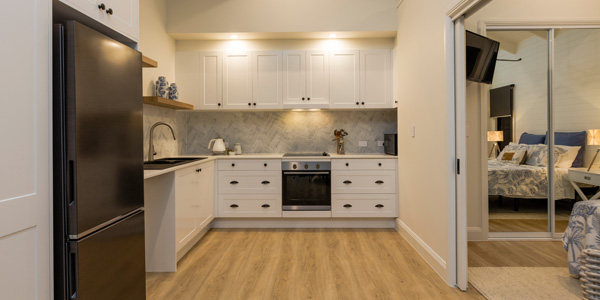
You might find a reverse mortgage a more budget-friendly and tax-friendly way to raise the capital needed to create the ADU (Accessory Dwelling Unit) for your daughter. As would be true if you took out a second mortgage, you’d remain responsible for property taxes. homeowner’s insurance, association fees, and overall maintenance costs on your own home. However, with a reverse mortgage, so long as at least one of you continues to occupy your home, there will be no monthly mortgage payments. As you make withdrawals from your line of credit to pay the contractors, those will be tax-free.* In fact, the un-borrowed portion of your housing equity will be guaranteed to grow at the same rate as that being charged on the outstanding balance.

There will undoubtedly be many details to work out with your daughter as well as your estate planning lawyer and tax adviser, but the beauty of the plan is that you’d be using your housing wealth to create housing for your daughter convenient to her place of work and close to you! 

*Please consult a tax advisor.

David Garrison, NMLS ID 1595194. Mutual of Omaha Mortgage, Inc. dba Mutual of Omaha Reverse Mortgage, NMLS ID 1025894. 3131 Camino Del Rio N 1100, San Diego, CA 92108. Indiana-DFI Mortgage Lending License 43321. Michigan 1st Mortgage Broker/Lender/Servicer Registrant FR0022702. These materials are not from HUD or FHA and the document was not approved by HUD, FHA or any Government Agency. Subject to credit approval. For licensing information, go to: www.nmlsconsumeraccess.org

Equal Housing Lender 

#303: Using a reverse mortgage to restore income stability post-divorce

POST-DIVORCE, HOME EQUITY HELPS RESTORE EQUILIBRIUM 

In the two years since you retired, life has seemed to be on a negative turn. After 35 years of marriage (three grown children and a couple of grandkids) – last year, your husband moved out and initiated divorce proceedings.

In the divorce, (which was mediated), there was never any doubt about who would be allowed to stay in the home (you had inherited the house from your parents and it had remained titled in your name). However, you were ordered to transfer a chunk of your own retirement savings to him (to make up for the fact that he’d contributed to maintain the place and make improvements). One positive factor in all this is that, prior to your husband’s decision to end the marriage, a number of upgrades were done on the property to make it suitable (for the two of you, you’d believed at the time!) to “age in place”. 

Taking stock of your own finances going forward, you’re reassured that despite the forced transfer of funds to your now” ex,” most of the nest egg accumulated over the course of your own professional career is intact; you have good medical and long term care insurance in place, Still, you’re now realizing how challenging it might prove to be to support your own needs and keep up with property taxes, homeowner’s insurance association fees, and overall maintenance all on your own.

The data may be of only small comfort, but “gray divorce”, which is divorce occurring among adults age 50 and older (what you’ve just experienced), is a growing phenomenon; which, according to a report in the National Library of Medicine, can cause as much as a 45% drop in women’s standard of living post-divorce.

The silver lining in your own divorce story is to be found in your housing wealth. While you’ve needed to transfer a portion of your retirement savings to your ex, the equity in your home can be accessed through a reverse mortgage line of credit. And while it’s true you will remain solely responsible for property taxes, homeowner’s insurance, association fees and overall maintenance costs, your withdrawals will be tax-free.* The unborrowed portion of your housing equity will be guaranteed to grow at the same rate as that being charged on the outstanding balance, and so long as you continue to occupy the home, there will be no monthly mortgage payments.** What’s more, neither you nor your estate will ever owe more than the home’s value (a reverse mortgage is a non-recourse loan).

As you embark on your post- gray divorce future, your home equity can help restore some measure of equilibrium to your life.

*Please consult a tax advisor.

**Borrower must occupy home as primary residence and remain current on property taxes, homeowner’s insurance, the costs of home maintenance, and any HOA fees.

David Garrison, NMLS ID 1595194. Mutual of Omaha Mortgage, Inc. dba Mutual of Omaha Reverse Mortgage, NMLS ID 1025894. 3131 Camino Del Rio N 1100, San Diego, CA 92108. Indiana-DFI Mortgage Lending License 43321. Michigan 1st Mortgage Broker/Lender/Servicer Registrant FR0022702. These materials are not from HUD or FHA and the document was not approved by HUD, FHA or any Government Agency. Subject to credit approval. For licensing information, go to: www.nmlsconsumeraccess.org

Equal Housing Lender 

#302: Using a reverse mortgage to avoid “boldness regrets”

BOLDLY VENTURING OUT WHILE STAYING SAFELY AT HOME 

Overall, looking back over the five years since you retired, the two of you are generally satisfied that your careful planning has “paid off”. You’ve been able to check all the important items “off your list” – the home remodel and system upgrade, the life/long term care insurance policy, the prepaid funeral arrangements, the auto maintenance warranties, plus visits to (and gifts to) kids and grandkids, not to mention updated estate planning documents. Every one of these things, you’re proud to say, was accomplished with zero debt incurred. Life has settled into a very pleasant routine. Active members of your local community center, you’ve enjoyed cultural events and exercise classes there along with a circle of close friends.

Then, after participating in a book club discussion of the Daniel H. Pink book, The Power of Regret: How Looking Backward Moves Us Forward, 

you couldn’t help but realize that you really do have regrets. Has being so orderly and well-planned meant there’s never going to be “more” and “bolder”? Once that “seed” was planted in your minds, you agreed to each come up with ideas for – and research – the costs and steps needed to implement a “bold venture” in the form of travel, which you agreed would include as many family members as possible. So far, you’ve both been gravitating towards the concept of a trip to Europe or Africa. However, while you agreed that working on the details feels “freeing”, as lifelong planners and careful money managers, you’re not sure you can muster sufficient financial “boldness” to move ahead.

The path to financing your “more and bolder” venture with the least disruption to your carefully budgeted retirement finances might be through your housing wealth in the form of a reverse mortgage line of credit. Once the details of the trip itself have been agreed upon, you can use tax-free* withdrawals to pay for the expenses. There will be no required monthly or quarterly mortgage payment**, and the “unborrowed” portion of your housing wealth will be guaranteed to grow at the same rate as the interest being charged on borrowed funds.

You’d be boldly venturing out – while staying safely at home – continuing your “very pleasant routine”!

*Please consult a tax advisor.

**Borrower must occupy home as primary residence and remain current on property taxes, homeowner’s insurance, the costs of home maintenance, and any HOA fees.

David Garrison, NMLS ID 1595194. Mutual of Omaha Mortgage, Inc. dba Mutual of Omaha Reverse Mortgage, NMLS ID 1025894. 3131 Camino Del Rio N 1100, San Diego, CA 92108. Indiana-DFI Mortgage Lending License 43321. Michigan 1st Mortgage Broker/Lender/Servicer Registrant FR0022702. These materials are not from HUD or FHA and the document was not approved by HUD, FHA or any Government Agency. Subject to credit approval. For licensing information, go to: www.nmlsconsumeraccess.org

Equal Housing Lender