

A reverse mortgage allows homeowners, typically aged 62 or older, to convert home equity into cash without selling their home or making monthly payments. Key pros include no obligatory mortgage payments, tax-free proceeds, optional flexible payment options, and protection against owing more than the home’s value. Main cons include significant upfront costs and increasing loan balance that can reduce home equity.
Key Pros:
- No monthly mortgage payments: Borrowers can eliminate monthly payments, which can ease financial pressure and allow seniors to age in place.
- Tax-free funds: Proceeds are generally not considered taxable income, and do not affect Social Security or Medicare benefits.
- Flexible disbursement options: Borrowers can choose to receive funds as a lump sum, monthly payments, a line of credit, or a combination.
- Non-recourse loan: Borrowers or heirs will never owe more than the home’s value when the loan is repaid, regardless of the loan balance.
- Retain home ownership: Borrowers keep the title and can remain in their home, provided they fulfill obligations like property maintenance, taxes, and insurance.
- Heirs have multiple options: When the homeowner leaves the home, heirs may repay the loan, sell the home and keep surplus equity, or, if the loan exceeds the home’s value, surrender the property with no further obligation.
Key Cons:
- Accruing fees: Reverse mortgages typically have higher closing costs, the most significant of which is the upfront FHA Mortgage Insurance Premium.
- Decreasing home equity: If no payments are made, an absolute right of the homeowner, the loan balance grows over time, reducing the equity left for heirs or the homeowners if they sell and move.
- Impact on inheritance: The growing loan balance can reduce the initial home value.
- Eligibility risks: As with all mortgages in the US, the homeowner must keep the home as their primary residence, maintain the property, and keep up with taxes and insurance.
- Potential impact on means-tested benefits: While Social Security and Medicare are not affected, receiving large lump sums could impact eligibility for Medicaid or Supplemental Security Income (SSI). This subset of homeowners should take care to draw only what they need to spend for the month.
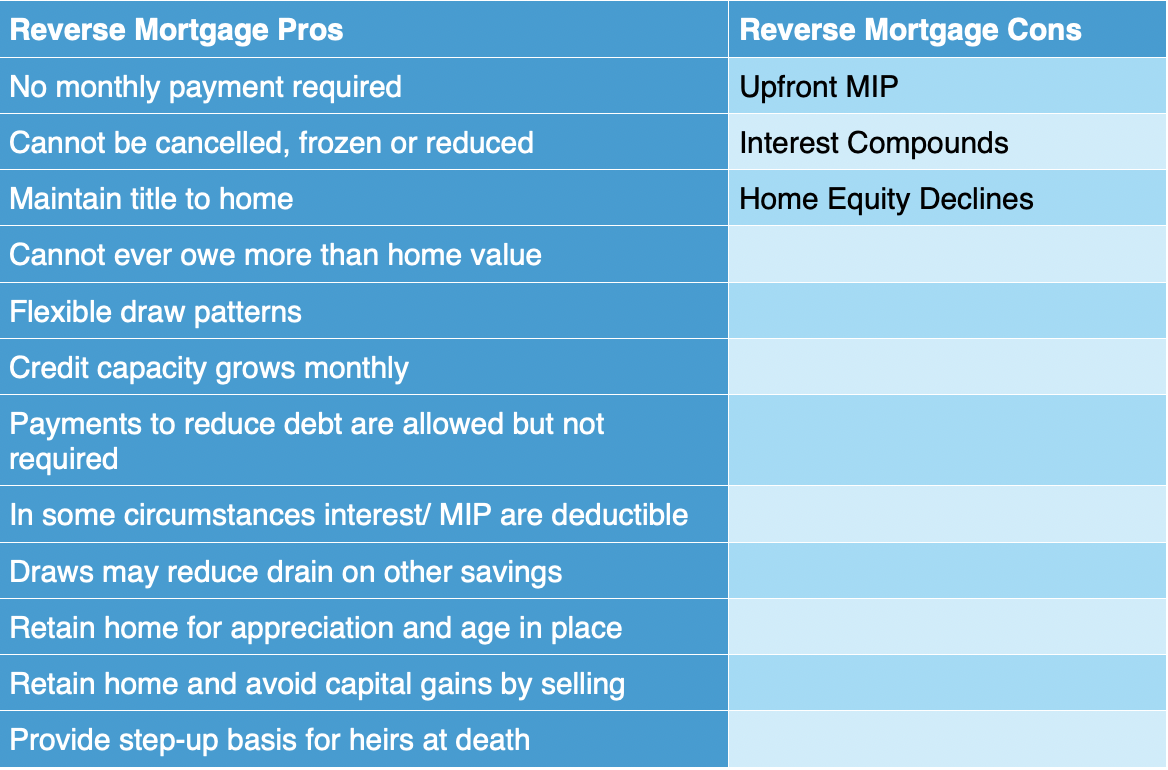
Clearly, the modern FHA-Insured reverse mortgage offers impressive benefits. The main drawbacks are related to cost, mostly the cost of insuring the loan. Many seniors find it reassuring that the loan is backed by the full faith and credit of the United States Government. Nevertheless, there are ways to reduce the overall cost of the reverse mortgage.
Key Methods for Reducing Overall Cost of Reverse Mortgages:
Payments on the reverse mortgage can be made or discontinued at any interval chosen by the homeowner
Paying the largest expense, the upfront MIP, instead of including it in the loan produces higher growth in available credit, and reduces the decline in home equity
Paying the largest expense, the upfront MIP as above, can result, for homeowners who itemize, in a tax reduction if the reverse mortgage is being used to purchase a new home or replace their purchase loan or to substantially renovate for a more desirable environment to age in place.
Making a large payment on an existing reverse mortgage in high-earning year to offset taxes
Taking draws from the reverse mortgage can be used in retirement planning :
Provide cash for living expenses while deferring Social Security
Meet irregular expenses such medical, aging home, or rising tax and insurance
Self-insure for long-term care. Don’t use it, don’t owe it
Substitute reverse mortgage for portfolio draws in down markets, avoid buying high and selling low
Avoid paying capital gains by not selling to meet expenses
In high appreciation areas, retain the home for continued wealth building
Restrict capital gains for heirs by passing home on stepped-up basis
In senior divorce, equalize housing and reduce drain on marital cash
Over the last decade, there has been an explosion in retirement planning uses for reverse mortgages. Financial professionals appreciate how a usually dormant asset, the home, can be mobilized to work in concert with other assets.