Skip to content

HECM vs. HELOC | What’s the difference?

Not sure which option fits your financial goal, and which might come with hidden surprises? Some options seem helpful at first glance but can lead to financial stress down the road.

Two common ways homeowners tap into their home equity are through a HECM (Home Equity Conversion Mortgage) loan or a HELOC (Home Equity Line of Credit) loan. They both provide financial relief, but they work in very different ways and are intended for different financial situations.

Understanding which option fits into your financial goals is key to making a confident, informed decision; one that will bring financial peace, not financial stress.

HECM Explained: What Is a HECM loan? 

A HECM loan is a government-insured reverse mortgage loan designed for homeowners aged 62** and older. It allows homeowners to access home equity without selling the home or making monthly mortgage payments*. 

Benefits of a HECM: 

  • No monthly loan payments* required. 
  • Flexible disbursement options: lump sum, monthly income, or line of credit. 
  • Can provide financial stability during retirement.  
  • Federally insured by the Federal Housing Administration (FHA). As of 2026, the lending limit is set at $1,249,125. Visit the FHA Mortgage Limits Lookup Tool for more information. 

Considerations: 

  • Interest accrues over time, reducing home equity. 
  • Upfront costs can include fees and mortgage insurance. 
  • Loan repayment is triggered when the homeowner sells, moves out, or passes away. 
  • Home upkeep and taxes continue to be the homeowner’s responsibility. 

HELOC Explained: What Is a Home Equity Line of Credit? 

A HELOC is a revolving line of credit based on the equity in your home. It’s commonly used for home improvements, education expenses, or emergency funding. 

Benefits of a HELOC: 

  • Borrow only what you need, when you need it 
  • Interest-only payments during the draw period 
  • Typically lower interest rates than credit cards 

Considerations: 

  • Monthly payments* required after the draw period 
  • Variable interest rates can increase costs over time 
  • Requires good credit and income for approval 

HECM vs. HELOC: Side-by-Side Comparison
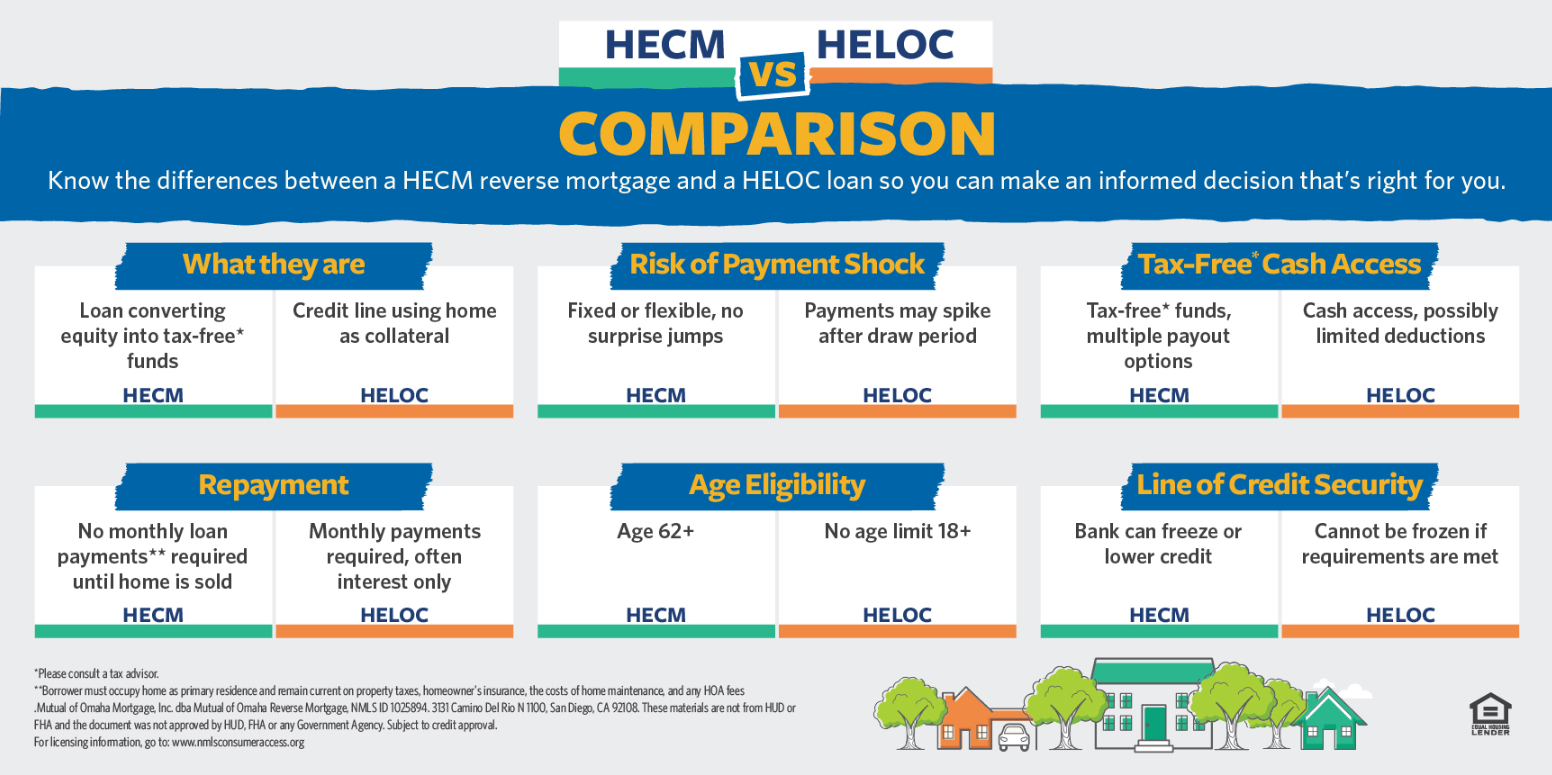
Infographic comparing HECM vs. HELOC across key criteria like repayment, eligibility, risk, tax-free cash access, and credit requirements for homeowners considering their options.

Which Option Is Better for You? 

For Retirees Seeking Income Stability 

A HECM loan may be ideal if you’re retired and want to stay in your home while accessing cash without monthly payments*. 

For Homeowners Needing Flexible Access 

A HELOC is better suited for short-term borrowing needs like renovations or unexpected expenses, especially if you’re still working. 

For Estate Planning 

HECMs reduce home equity, potentially affecting inheritance. HELOCs preserve equity only if repaid responsibly. 

HECM vs. HELOC in Action

Susan’s Story – Choosing a HECM

At 68, Susan owned her home outright and had always taken pride in maintaining her independence. But as healthcare costs began to rise, she found herself needing extra income to cover medical bills and ongoing care. Selling her home wasn’t an option—she loved her neighborhood and the memories tied to her house. 

That’s when Susan learned about a Home Equity Conversion Mortgage (HECM). It allowed her to tap into the value of her home without having to move or take on monthly loan payments*. The funds she received helped ease her financial stress and gave her the flexibility to manage her healthcare needs comfortably. 

With a HECM, Susan was able to stay in the home she loved while gaining the financial support she needed—without adding a monthly burden to her fixed retirement income. 

John’s Story – Choosing a HELOC

At 45, John had big plans for his home. His kitchen, once charming, was now outdated and inefficient. After exploring his options, he decided to use a Home Equity Line of Credit (HELOC) to borrow $30,000 for a full renovation. 

The process was smooth. With the funds available, John hired a contractor, upgraded his appliances, and transformed the space into a modern, functional kitchen. He appreciated the flexibility of the HELOC, which allowed him to borrow only what he needed and repay it over time. 

John was fortunate—he was still working full-time and had a stable income, so the monthly payments fit comfortably into his budget. But he knew the repayment terms would eventually shift, and he’d need to pay both principal and interest. He made a plan to pay off the balance before retirement to avoid financial strain later. 

John’s story shows how a HELOC can be a helpful tool—as long as you understand the long-term commitment and have a strategy to manage payments, especially before transitioning to a fixed income. 

Buyer’s Guide: Questions to Ask Before Choosing Between HECM and HELOC

  • Do I plan to stay in my home long-term? 
  • Do I meet the age requirement for a HECM? 
  • Am I comfortable with monthly payments? 
  • How much equity do I have in my home? 
  • What are the fees and interest rates? 
  • How will this affect my financial future and estate planning? 

Final Thoughts 

Both HECMs and HELOCs offer a valuable option to access home equity, but they serve different needs. A HECM is well-suited for older homeowners who want to access their home equity without taking on monthly payments*, making it a practical option for those on a fixed income. In contrast, a HELOC offers flexible access to funds but requires regular payments, which may be more manageable for homeowners who are in a position to make monthly payments. 

Before making a decision, consult a financial advisor and compare offers from multiple lenders. Understanding your goals and financial situation will help you choose the option that best supports your financial goals.  

* Borrower must occupy home as primary residence and remain current on property taxes, homeowner’s insurance, the costs of home maintenance, and any HOA fees. 

** Due to state restrictions, some states have a higher minimum age than 55. 

Reverse mortgage borrower must occupy home as primary residence and remain current on property taxes, homeowner’s insurance, the costs of home maintenance, and any HOA fees.   

This information is intended to be general and educational in nature and should not be construed as financial advice. Consult your financial advisor before implementing financial strategies for your retirement.  
What Happens If You Inherit a House with a Reverse Mortgage? FAQ


Heirs often have questions about what happens after a reverse mortgage ends. This brief guide provides clear answers to the most common concerns, helping families understand the next steps with confidence.

Inheriting a home can be a meaningful gift—but if that home has a reverse mortgage, it can also raise a lot of questions. Do you have to pay off the loan? Can you keep the house? What if the loan is more than the home is worth? 

If you’re navigating a reverse mortgage inheritance, you’re not alone. This guide answers the most common questions about inheriting a house with a reverse mortgage, helping you understand your rights, responsibilities, and options. 

Question: Can You Inherit a House That Has a Reverse Mortgage? 

Answer: Yes, you can inherit a home with a reverse mortgage. However, the reverse mortgage loan repayment becomes due when the homeowner passes away. As the heir, you’ll need to decide how to handle the loan—whether that means keeping the home, selling it, or transferring it back to the lender. 

This is a key part of reverse mortgage estate planning, and understanding your options early can help you avoid unnecessary stress. 

Find a loan officer in your area.
Illustration of a yellow briefcase, a checklist on a clipboard, and a stack of dollar bills, representing business, tasks, and money.

Question: Are Heirs Responsible for the Reverse Mortgage Debt? 

Answer: Heirs are not personally responsible for the reverse mortgage debt unless they choose to keep the home or manage its sale. If you don’t want to take on this responsibility, you can sign the deed over to the lender and allow them to handle the reverse mortgage foreclosure process. 

This flexibility is one of the reasons reverse mortgages are often used in estate planning. 

Question: What If the Loan Is More Than the Home’s Value? 

Answer: Reverse mortgages are non-recourse loans, which means you’ll never owe more than the home is worth. If the loan balance exceeds the market value, the lender cannot pursue other assets from the estate or the heirs. 

If you sell the home for more than the loan balance, you keep the difference. If you decide to keep the home, you’ll only need to repay the lesser of the loan balance or 95% of the home’s appraised value. This is a key protection built into reverse mortgage and heirs policies. 

Bottom Line

Inheriting a home with a reverse mortgage requires careful consideration of both legal and financial factors. Whether you want to keep the home, sell it, or walk away, it’s important to understand your rights and the reverse mortgage payoff options available to you. 

Before making any decisions, consult with a financial advisor or estate attorney. With the right guidance, you can navigate the complexities of reverse mortgage after death and make choices that align with your family’s needs and your loved one’s wishes. 

Reverse mortgage borrower must occupy home as primary residence and remain current on property taxes, homeowner’s insurance, the costs of home maintenance, and any HOA fees.   

This information is intended to be general and educational in nature and should not be construed as financial advice. Consult your financial advisor before implementing financial strategies for your retirement.  

Inheriting a Home with a Reverse Mortgage: A Step-by-Step Guide

Inheriting a home can be a meaningful gift, but when that home has a reverse mortgage, it also comes with important decisions. If you’re unsure what to do next, this step-by-step guide will walk you through the process of managing a reverse mortgage inheritance with clarity and confidence. 

Step 1: Consult a Professional

Before making any decisions, it’s wise to speak with professionals who can guide you through the legal and financial complexities of a reverse mortgage inheritance. Consider working with: 

  • An estate attorney 
  • A financial advisor 
  • A real estate agent familiar with reverse mortgages 

These experts can help you understand your rights, evaluate your options, and avoid costly mistakes. 

Step 2: Notify the Lender

As soon as possible after the homeowner’s passing, contact the reverse mortgage lender. This is a critical first step, as it officially triggers the loan’s “due and payable” status. The lender will send a notice outlining the timeline and your responsibilities as the heir. 

Before you can make any decisions about the property, you’ll need to confirm your legal right to it. This may involve: 

  • Going through probate 
  • Being named in a will or trust 
  • Transferring the deed into your name 

Step 4: Understand the Loan Balance and Home Value

Request a payoff statement from the lender and get a professional appraisal of the home. This will help you understand: 

  • How much is owed on the reverse mortgage 
  • How much the home is worth 
  • Whether it makes financial sense to keep or sell the property 

Step 5: Choose How to Settle the Loan

You have several options, depending on your goals and financial situation: 

Option 1: Keep the Home 

You can pay off the reverse mortgage using cash, refinancing, or other inherited assets. This is a good choice if you want to live in the home or keep it in the family. 

Option 2: Sell the Home 

Selling the home allows you to use the proceeds to pay off the loan. If the sale price exceeds the loan balance, you keep the difference. 

Option 3: Sign Over the Home 

If you don’t want to keep or sell the home, you can sign a deed in lieu of foreclosure. This transfers ownership to the lender and ends your responsibility. 

Option 4: Do Nothing 

If you take no action, the lender will foreclose on the home. Because reverse mortgages are non-recourse loans, you won’t owe more than the home’s value. 

Step 6: Act Within the Timeline

Heirs typically have six months to settle the loan, with the possibility of two 90-day extensions (up to 12 months total). It’s important to stay in communication with the lender and request extensions if needed. 

Final Thoughts

Inheriting a home with a reverse mortgage doesn’t have to be overwhelming. By following Heirs typically have six months to settle the loan, with the possibility of two 90-day extensions (up to 12 months total). It’s important to stay in communication with the lender and request extensions if needed. 

Reverse mortgage borrower must occupy home as primary residence and remain current on property taxes, homeowner’s insurance, the costs of home maintenance, and any HOA fees.  

This information is intended to be general and educational in nature and should not be construed as financial advice. Consult your financial advisor before implementing financial strategies for your retirement. 
What Happens If You Inherit a House with a Reverse Mortgage? FAQ

Inheriting a Home with a Reverse Mortgage? Here’s What Heirs Need to Know
A clear, concise guide answering the most frequently asked questions about what happens next.

Inheriting a home can be a meaningful gift but if the home has a reverse mortgage, it can also raise a lot of questions. Do you have to pay off the loan? Can you keep the house? What if the loan is more than the home is worth? 

If you’re navigating a reverse mortgage inheritance, you’re not alone. This guide answers common questions about inheriting a house with a reverse mortgage, helping you understand your rights, responsibilities, and options. 

Question: Can You Inherit a House That Has a Reverse Mortgage? 

Answer: Yes, you can inherit a home with a reverse mortgage. However, the reverse mortgage loan repayment becomes due when the homeowner passes away. As the heir, you’ll need to decide how to handle the loan—whether that means keeping the home, selling it, or transferring it back to the lender. 

This is a key part of reverse mortgage estate planning, and understanding your options early can help you avoid unnecessary stress. 

Find a loan officer in your area.
Illustration of a yellow briefcase, a checklist on a clipboard, and a stack of dollar bills, representing business, tasks, and money.

Question: Are Heirs Responsible for the Reverse Mortgage Debt? 

Answer: Heirs are not personally responsible for the reverse mortgage debt unless they choose to keep the home or manage its sale. If you don’t want to take on this responsibility, you can sign the deed over to the lender and allow them to handle the reverse mortgage foreclosure process. 

This flexibility is one of the reasons reverse mortgages are often used in estate planning. 

Question: What If the Loan Is More Than the Home’s Value? 

Answer: Reverse mortgages are non-recourse loans, which means you’ll never owe more than the home is worth. If the loan balance exceeds the market value of the home, the lender cannot pursue other assets from the estate or the heirs.

On the other hand, if the home sells for more than the loan balance, the remaining equity goes to you. And if you choose to keep the home, repayment is limited to the lesser of the loan balance or 95% of its appraised value. This is a key protection built into reverse mortgage and heirs’ policies. 

Final Thoughts

Inheriting a home with a reverse mortgage requires careful consideration of both legal and financial factors. Whether you want to keep the home, sell it, or walk away, it’s important to understand your rights and the reverse mortgage payoff options available to you. 

Before making any decisions, consult with a financial advisor or estate attorney. With the right guidance, you can navigate the complexities of reverse mortgage after death and make choices that align with your family’s needs and your loved one’s wishes. 

Reverse mortgage borrower must occupy home as primary residence and remain current on property taxes, homeowner’s insurance, the costs of home maintenance, and any HOA fees.   

This information is intended to be general and educational in nature and should not be construed as financial advice. Consult your financial advisor before implementing financial strategies for your retirement.  
How Does a Reverse Mortgage Work? 

As you live in or reach retirement, you may have asked yourself: Will I have enough money to live? How can I afford my mortgage payment? Can I stay in my home, or will I be priced out? A reverse mortgage might be the answer you’re looking for.  

Your mortgage payment is likely the biggest expense in your household budget. In retirement, it can be even more of a financial strain. It’s especially frustrating when your home, your greatest asset, has equity you can’t access without a loan like a Home Equity Line of Credit (HELOC).    

A reverse mortgage offers a solution that unlocks equity, giving you access to funds and eliminating your monthly mortgage payment altogether.  

If you own your home and are over 61, a reverse mortgage can turn home equity into usable money to cover everyday expenses and unexpected costs, or just enjoy retirement.  A reverse mortgage is a proven method many in or near retirement use to access equity.  

So, what is a reverse mortgage, and how does it work? It can seem confusing or complicated to navigate, and we want to bring clarity to the subject. In this article, we break it down into simple terms.

What is a Reverse Mortgage?

A reverse mortgage is more straightforward than it seems. It allows you to turn your home’s equity into money you can use while continuing to live in your home and takes away the stress of monthly mortgage payments. A reverse mortgage is designed with retirees in mind to offer financial flexibility.  

This type of mortgage offers a secure way to access your home’s equity with simple and clear requirements, which we’ll explore later in this article. In short, the homeowner must be 62 or older, own their home outright, or have equity, and the home must be their primary residence. 

Common reasons for obtaining a reverse mortgage:  

  • Supplement retirement income  
  • Cover healthcare costs  
  • Home maintenance or repair expenses  
  • Funds for emergencies or unexpected events  
  • Travel or fulfill life goals

The cost of living continues to rise, including medical care and emergency expenses. As we age, these expenses become an even bigger concern. A reverse mortgage can offer financial relief by providing access to your home’s equity. Depending on your needs, you can choose monthly payments, a lump sum, a line of credit, or a combination.  

Get Your Free Reverse Mortgage Guide Here!

Types of Reverse Mortgages  

Not all reverse mortgages are the same. There are a few options available, each designed to meet different needs and financial situations. Understanding these options can help you choose the right one for your needs. Below, we cover the most popular reverse mortgage products and how they work.  

For a side-by-side comparison of loan types, see the chart at the bottom of this section.  

Home Equity Conversion Mortgage (HECM) 

The most common type of reverse mortgage, also the product that made the term “reverse mortgage” so well known, is the HECM loan. Because this type of loan is backed by the Federal Housing Administration (FHA), you are protected from owing more than the house is worth when it’s time to repay.  

A good option for borrowers with equity in their house who would benefit from a supplement to their income or funds to cover expenses.  

HECM for Purchase  

You might be ready to downsize but have an interest in obtaining a reverse mortgage. A HECM for purchase allows you to tap into your equity to help fund the purchase of a new property. You will have the same benefits of a traditional HECM loan with no monthly mortgage payments and FHA-backed loan protection.  

A good option for borrowers who have equity in their home and would prefer to downsize or move to a home more appropriate for aging in place.  

Jumbo Reverse Mortgage 

While HECM loans are subject to the FHA HECM loan limits, with a jumbo reverse mortgage, homeowners can borrow up to $4 million depending on their qualifications. Like other reverse mortgages, there are no monthly loan payments. However, because of the larger amounts, the interest rates can be higher than other types of loans.  

A jumbo loan doesn’t have FHA protections, but it is a non-recourse loan, meaning the loan repayment amount won’t exceed the property’s assessed value.

A good option for homeowners who want to access more than traditional HECM loans allow. 

Comparing Reverse Mortgage Types

HECMHECM for purchaseJumbo Reverse Mortgage
PurposeAccess equity without selling your home  Buy a new home while accessing reverse mortgage benefits Access equity in high-value homes 
Primary useSupplement retirement income, cover expenses Downsize or move to a home better suited for retirement Supplement retirement income, cover expenses for high-value properties 
Eligibility age62 and older  62 and older  Varies by lender (often 55 or older) 
Property typeSingle-family, FHA-approved condos, or manufactured homes meeting FHA standardsSingle-family, FHA-approved condos, or manufactured homes meeting FHA standardsHigh-value homes, not always FHA-standards 
Loan limitUp to $1,249,125 (2026 limit) Up to $1,249,125 (2026 limit) Over $1 million (varies by lender) 
FHA backedYesYesNo

Understanding the Tradeoffs 

There are many factors to consider when making any financial decision. When you are in or approaching retirement and dealing with what is typically your largest asset, your home, it is even more important to research your options and make an informed decision carefully.  

We recommend our guide to learn more, but here are a few pros and cons:

Reverse Mortgage Pros

  • Access cash without selling your home
  • No monthly mortgage payments
  • Flexible payout options
  • Non-recourse feature for borrower protection 

Reverse Mortgage Cons

  • Reduces home equity over time
  • Costs can add up (interest, fees, insurance)
  • It may affect inheritance plans or financial goals

How a Reverse Mortgage Works 

To understand how a reverse mortgage works, we will explain the process, from approval and how you receive funds to how and when the mortgage loan needs to be paid back.  

With a reverse mortgage, you borrow money against the equity in your home. Equity is the difference between the amount owed on your current mortgage and the market assessment for the value of your home. A reverse mortgage can be an attractive option if you own your home outright or have equity. Instead of making monthly payments to a lender, the lender pays you.

More specifically, the reverse mortgage lender takes the equity in your home and pays off the remaining balance of your traditional mortgage. With the amount left over, the lender disburses a tax-free amount to you, depending on your loan type and payout preferences.  

The amount you have access to depends on many factors. In the most common, a Home Equity Conversion Mortgage (HECM), the principal limit is based on:  

  • Age of those on the mortgage documents  
  • Interest rates  
  • Home’s value and equity 
  • HECM lending limit for that year (in 2026, the HECM limit is $1,249,125) 

Generally, the older you are and the more equity you have, the more you can borrow with lower interest. A mortgage broker can help you determine the amount you could borrow based on your situation.  

Flexible Borrowing Options 

Reverse mortgages offer flexible ways for you to receive payments. These include:  

  • Lump sum payout: Ideal for major expenses, like home repairs, medical bills, or paying off debts. 
  • Monthly payments: A once-a-month payout that can supplement retirement income.
  • Line of credit: Access funds as needed, with the bonus of unused amounts growing over time. 
  • Combination: Mix and match the above methods to meet current and future financial needs. 

Each option lets you customize your reverse mortgage to match your needs.  

Repayment of a Reverse Mortgage

Repayment of a reverse mortgage occurs when one of the following happens:  

  • The home is sold 
  • The home is no longer the primary residence of the borrower
  • The primary owner or borrower passes away 

When one of these occurs, the loan balance is due to the lender, including the amount borrowed, interest, and any fees. In most cases, the home is sold to repay the loan. 

Borrower Protections 

With frequent concerns about repayment, reverse mortgages have built-in protections for you as the borrower. One common question is what happens if the amount owed ends up being more than the home is worth. It is a legitimate fear but unnecessary. A benefit of a reverse mortgage is non-recourse protection: you and your beneficiaries won’t owe an amount more than the home’s assessed value when it’s sold, even if the loan balance exceeds it. It’s a reassuring safeguard.  

Interest and Fees 

While you pay no monthly payments, interest and fees accrue on the loan balance. These costs are added to the total amount owed and are repaid when the loan comes due. 

Borrower Responsibilities 

While interest and fees accrue over time, you will make no monthly mortgage payments. Borrowers are only responsible for staying current on property taxes, insurance, and basic home maintenance.  

A reverse mortgage can offer a practical way to access your home’s value while still living there. With flexible payout options and built-in protections, it can be a smart choice for retirees looking to enhance their financial lives.  

Get Your Free Reverse Mortgage Guide Here!

Reverse Mortgage Requirements

The qualifications for a reverse mortgage vary.  HECM and HECM for purchase loans generally have the same requirements, while jumbo reverse mortgage loans differ. Some of the information is included in the chart above, but here is a further look:

  • Age: 62 and older; 55+ in some states for a jumbo reverse mortgage.  
  • Residency: Must be your primary residence 
  • Home ownership status: Own the home outright or have equity.  
  • Property type: Single-family home, a 2–4-unit dwelling where the borrower resides in one unit, or an FHA-approved condo or manufactured home; for jumbo loans, there are different qualifications.  
  • Property condition: Should be in a well-kept condition.  
  • Financial assessment: There is no general credit score requirement for reverse mortgages. Instead, lenders look at the condition of your home, if you pay your property taxes, and the status of your homeowner’s insurance, among other items.  
  • Counseling: Every borrower goes through a mandatory counseling session with a third-party counselor approved by the U.S. Department of Housing and Urban Development (HUD) to ensure you fully understand your loan’s terms.  
  • Financial obligations: Ability to pay upkeep on the home, property taxes, homeowner’s insurance, and homeowner’s association fees, if applicable. 

Frequently Asked Questions  

  1. Can you sell a home that has a reverse mortgage?  
    • Yes, the proceeds from the sale will go to pay off the reverse mortgage, and the remaining amount will be disbursed to the homeowner or beneficiaries.  
  2. When do I have to pay off a reverse mortgage?  
    • A reverse mortgage must be repaid if one of the following things happen:  
      • The house is sold
      • The house is no longer the primary residence
      • The borrower passes away
  3. How do you pay off a reverse mortgage? 
    • The balance on a reverse mortgage, including the borrowed amount, interest, and fees, is usually paid off upon the home’s sale.  
  4. What happens if the loan balance exceeds the home’s value? 
    • Reverse mortgages are non-recourse loans, meaning the final loan balance cannot exceed the home’s value.  
  5. Can I outlive a reverse mortgage? 
    • No, if you or another borrower on the reverse mortgage lives in the home full-time, no repayment is due on the loan.  

Final Thoughts 

A reverse mortgage can be a powerful tool if you are in or nearing retirement, have equity in your home, and would benefit from having additional money to help with expenses. Like any big financial decision, it is important to consider all the facts before making an informed decision. 

Borrower must occupy home as primary residence and remain current on property taxes, homeowner’s insurance, the costs of home maintenance, and any HOA fees. 

This information is intended to be general and educational in nature and should not be construed as financial advice. Consult your financial advisor before implementing financial strategies for your retirement. 
Expenses in Retirement: What to Expect and How to Prepare 

Retirement marks a significant milestone in life, offering a chance to enjoy the fruits of your labor, pursue long-awaited dreams, and spend quality time with loved ones. However, as you transition from a regular paycheck to relying on savings and other sources such as Social Security benefits, it’s important to have a clear understanding of the expenses you’ll encounter. 

In this article, we will explore what expenses you can expect in retirement and how to financially prepare for this next chapter of life. The goal is to better prepare for the financial realities of retirement and ensure that you can enjoy this new phase of life with greater peace of mind. 

Expenses in Retirement: What to Expect 

Housing remains one of the largest expenses for retirees. According to Fidelity, housing costs can account for up to 42 percent of a retiree’s budget. This includes mortgage or rent payments, property taxes, and maintenance and repairs.  

These expenses can strain your retirement budget if you haven’t set aside a contingency fund for such events. Financial experts recommend maintaining an emergency fund specifically for home repairs and modifications to mitigate these unexpected costs. 

Many retirees opt to downsize or relocate to more affordable areas to manage these costs better.  

The ongoing responsibility of maintenance and repairs can be unpredictable. According to a report by the Society of Actuaries, major home repairs and upgrades were the most common shock that retirees say they had to face.  

Major repairs such as a roof replacement, plumbing issues, or HVAC system failures can be costly and often arise without warning.  

According to an analysis by Zillow and Thumbtack, when you add in all of the “hidden costs” that come with owning a home, the homeowners spend $14,000 per year on average. This includes costs such as mortgage payments, property taxes, insurance, HOA fees (where applicable), utilities, and home maintenance.  

When it comes to maintenance and upkeep, the average cost annually is $6,413, according to the same analysis. 

Below is a breakdown of the average costs of some of the most common repairs:   

Common Home Repairs Average Cost 
Roof Repairs   $150 to $8,000 
Roof Replacement $5,855 to $13,073 
Plumbing Repairs $175 to $450 
Exterior Paint  $3,000 
Water Heater Replacement $1,300 
Foundation Repairs $5,018 
HVAC Repairs $130 to $2,000 

The Society of Actuaries recommends that retirees “Evaluate whether current housing is affordable based on anticipated finances.” 

If you find that your housing expenses are eating up too much of your budget or you don’t have enough to cover needed repairs and upgrades, one option to consider is a reverse mortgage loan. A reverse mortgage will eliminate your monthly mortgage payment and allow you to access your home equity in the form of cash.   

Sources: 

https://www.thisoldhouse.com/roofing/reviews/cost-of-roof-repair

https://www.angi.com/articles/how-much-does-roof-replacement-cost.htm

https://www.angi.com/articles/how-much-will-plumbing-repair-cost.htm

https://www.forbes.com/home-improvement/painting/painting-house-exterior-cost

https://www.angi.com/articles/how-much-does-foundation-repair-cost.htm

https://www.angi.com/articles/how-much-does-water-heater-installation-cost.htm

https://www.angi.com/articles/how-much-hvac-repair-cost.htm

Healthcare is often the most significant and unpredictable expense in retirement.  

A 65-year-old couple will need approximately $315,000 to cover healthcare costs throughout their retirement, according to Fidelity’s 2023 Retiree Health Care Cost Estimate. For an individual, the estimated cost is $157,500.  

Fidelity’s estimate is based on an individual enrolled in traditional Medicare, which helps pay for costs such as doctor appointments, hospital stays, and other services. It also assumed the individual is enrolled in a Medicare prescription drug plan, also known as Medicare Part D.  

Fidelity says that means that the expected costs are “above and beyond what Medicare covers.” 

T. Rowe Price says that while the average cost for medical expenses throughout retirement sounds like a big number, “half of retirees with traditional Medicare (Parts A and B), a prescription drug plan (Part D), and Medigap will spend less than $900 per year on out‑of‑pocket expenses.” 

According to its findings, “Only 1 in 10 will likely spend more than $4,200 per year on out‑of‑pocket expenses. Also, it’s not necessarily true that someone spending $4,200 in out‑of‑pocket expenses this year will keep doing so for the rest of his or her life.” 

If you require in-home care, the average cost nationwide ranges from $1,950 per month to $5,720 depending on how many hours are required, according to A Place for Mom.  

To offset healthcare costs in retirement, Fidelity recommends that retirees consider a health savings account (HSA) because of the tax advantages it offers.  

Illustration of tooth being magnified and examined

Even though dental costs are a medical expense, it deserves its own section because major dental expenses are the second most common financial shock that retirees report, right after major home repairs, according to the Society of Actuaries report on Shocks and the Unexpected: An Important Factor in Retirement.  

According to the report, 24 percent of retirees reported major dental expenses as one of the financial shocks they experienced.  

“Dental expenses are frequently unexpected and uninsured,” the Society of Actuaries explains.  

According to the U.S. Centers for Medicare and Medicaid Services (CMS), “In most cases, Medicare doesn’t cover dental services like routine cleanings, fillings, tooth extractions, or items like dentures.” 

The exception is when dental treatment is required as part of another medical procedure, such as if an oral exam is required before a heart valve replacement, CMS explains.  

However, some Medicare Advantage plans, also known as Medicare Part C, will include a dental plan, but Medicare Supplement plans do not.  

If your plan does not include dental coverage, it can be purchased separately. The plans vary from those that include basic dental care to coverage for major care. Most health insurance companies that offer Medicare plans, also offer dental plans.  

Illustration of money

Everyday expenses such as groceries, dining out, utilities, and transportation continue to be a part of your budget in retirement.  

The cost of food can vary widely. For instance, a comfortable retirement budget in Florida includes about $130 per week for groceries and $80 for dining out, according to Explore55Plus

While some costs may decrease, like commuting expenses, others might remain stable or even increase depending on your lifestyle choices.  

While inflation is starting to moderate, prices for everyday goods are still at an all-time high. For example, food prices have increased by more than 25 percent since the last election in November 2020, according to Yahoo. And gas prices have already risen by 14 percent in 2024, ABC News is reporting.  

These rising prices only serve to put additional pressure on the wallets of retirees, which can be tough, especially for those living on a fixed income.  

Keeping a close eye on these variable expenses and adjusting your budget accordingly can help maintain financial stability. 

If you’re a homeowner, tapping into your equity with a reverse mortgage in the form of monthly installments may help add a buffer to your monthly budget.  

Illustration of sun rising

Retirement is a time to enjoy hobbies, travel, and social activities. Allocating a portion of your budget to entertainment and leisure can enhance your quality of life.  

Whether it’s traveling the world, pursuing new hobbies, or spending time with family and friends, planning for these activities ensures you can enjoy your retirement to the fullest.  

For a more active lifestyle, increasing your retirement budget by about 6 percent is recommended to cover these costs, according to Fidelity.  

If your budget doesn’t allow for such costs, choose activities that won’t take as much of a financial toll such as volunteering, spending time with family, taking advantage of local events, joining a book club, or gardening.  

Be mindful of balancing these discretionary expenses with your overall financial plan to avoid overspending. 

Illustration of a family of 3, with a toddler in between their parents

Children may still need help long after they leave the home, and retirees might find themselves in a position where they need to provide financial support to family members, which can be unexpected and burdensome.  

This can include helping adult children with major expenses such as education costs, housing, or even supporting grandchildren.   

According to a Bankrate survey, 68 percent of parents with adult children step in with financial help when their children are in a pinch. To do so, the parents have had to dip into their retirement savings, emergency savings, and put off paying off debt or a specific financial goal. 

These family obligations can arise unexpectedly and require careful financial planning to ensure they don’t jeopardize your financial security. 

Financial emergencies, such as identity theft, significant investment losses, or the loss of a second income due to the passing of a spouse can also occur during retirement. These situations often require immediate financial resources and can disrupt your planned budget.  

Ensuring you have adequate insurance coverage and emergency savings in place can help mitigate the impact of these emergencies.  

It’s also wise to work with a financial advisor to develop a strategy for dealing with such contingencies. 

How to Prepare for Expenses in Retirement  

Planning for retirement is crucial to ensure a comfortable and financially secure future. With proper preparation, you can manage your expenses effectively and enjoy your golden years without financial stress. Here are some steps you can take to prepare for retirement expenses. 

Start by calculating your current monthly and annual expenses. Include housing, utilities, groceries, transportation, healthcare, insurance, entertainment, and any other regular costs. Use this as a baseline to project your future expenses. 

Consider how your expenses will change in retirement. Some costs may decrease, like commuting and work-related expenses, while others, such as healthcare and leisure activities, may increase. Factor in inflation and potential lifestyle changes.  

Estimate your Social Security benefits. You can use the Social Security Administration’s online tools to get an accurate estimate based on your earnings record and retirement age. 

Calculate the expected income from your retirement accounts, such as 401(k)s, IRAs, and pensions. Consider factors like withdrawal rates, required minimum distributions (RMDs), and tax implications. 

Include any other potential income sources, such as rental properties, part-time work, or investments.  

Create a detailed retirement budget by comparing your projected expenses with your estimated income. Identify any gaps and plan how to address them. 

Categorize your expenses into needs (essential costs like housing and healthcare) and wants (discretionary spending like travel and hobbies). Prioritize your spending to ensure essentials are covered first.  

Here are some free retirement budgeting tools that can help you get started:  

Establish an emergency fund with 6-12 months’ worth of living expenses to cover unexpected costs. This fund provides a financial cushion and prevents you from dipping into retirement savings. 

Ensure the emergency fund is easily accessible, ideally in a high-yield savings account or a money market account. 

Another option if you don’t have the means to establish an emergency fund is to tap into your home equity through a reverse mortgage. A reverse mortgage loan gives borrowers several options for accessing their equity.  

One of those options is a line of credit, which works a lot like a home equity line of credit (HELOC), in which borrowers can access the funds on an as-needed basis. One benefit of the reverse mortgage credit line is that unused funds can grow.  

Familiarize yourself with Medicare options, including Parts A, B, C, and D, and supplemental plans (Medigap).  

“Those who purchased a Medicare supplement in addition to Medicare usually had their health care bills well covered so health care costs were usually not an issue,” according to the Society of Actuaries.  

Estimate your healthcare costs based on premiums, copays, and out-of-pocket expenses. 

In addition, you may want to consider purchasing long-term care insurance to cover potential expenses for assisted living, nursing homes, or in-home care. 

Look for ways to improve your monthly cash flow by prioritizing paying off high-interest debt, such as credit cards and personal loans, before retiring. Reducing debt lowers your monthly expenses and increases your financial security. 

If you have a mortgage, explore options such as refinancing to lower your payments or paying off the mortgage if financially feasible. 

If you are heading into retirement with high-interest credit card debt and a mortgage, it may be worth exploring how a reverse mortgage loan, available only to homeowners 62 or older, may help. 

When you take out a reverse mortgage, the first thing it does is pay off your current traditional mortgage and the monthly mortgage payments that go with it. Of course, borrowers are still responsible for paying the property taxes, homeowners’ insurance, and HOA fees, if applicable.  

For the remaining equity, you have the option to receive your funds as a lump sum, monthly payments, a line of credit, or a combination of those methods. Choose the one that will work best for your situation.  

To learn more about how a reverse mortgage may help, check out our Complete Guide to Reverse Mortgages.  

 While it’s impossible to predict every expense that might arise during retirement, being aware of potential expected costs and preparing for them can help ensure financial confidence going into retirement.  

Establishing an emergency fund and maintaining flexibility in your budget are crucial steps in managing these surprises.  

By planning ahead and seeking professional advice, you can navigate these challenges and enjoy a more secure and stress-free retirement. 

Reverse mortgage borrower must occupy home as primary residence and remain current on property taxes, homeowner’s insurance, the costs of home maintenance, and any HOA fees.   

This information is intended to be general and educational in nature and should not be construed as financial advice. Consult your financial advisor before implementing financial strategies for your retirement.  

Men’s Health Month: How to Stay Healthy After 60

June marks Men’s Health Month, a time dedicated to raising awareness about the importance of health and wellness for men of all ages.

For men over 60, maintaining a healthy lifestyle is especially important as it can significantly impact overall well-being and longevity.

How do you stay healthy after 60? What healthy habits should you prioritize at this stage in life?

We talked to five health and wellness experts to get their best tips and strategies for men over 60 looking to optimize their physical and mental health.

Whether you’re approaching this milestone or already there, it’s never too late to make positive changes for your health.

Let’s dive into the steps you can take to stay healthy and thriving after 60.

what to eat

It should be no surprise that we’re starting with diet. Maintaining a healthy diet is crucial for men over 60, as it can significantly impact overall well-being and longevity.  

Dr. Kevin Huffman, a Doctor of Osteopathic Medicine, board-certified bariatric physician, and CEO and Founder of Ambari Nutrition, highlights the broader benefits of a balanced diet.  

“One of the best things you can do for your health is eat a balanced diet full of fruits and vegetables, as well as whole grains,” Huffman said. “These give your body essential vitamins, minerals, and fiber, which can help ward off all types of chronic disease, including heart disease and diabetes.” 

And a healthy diet not only helps improve heart health but may also impact brain health. 

Huffman says that “research published in the Journal of the American Geriatrics Society (2022) suggests that a heart-healthy diet is associated with lower risk of cognitive decline.” 

Protein is another essential component of a healthy diet for older men. Evan Tunis, President of Florida Healthcare Insurance, recommends prioritizing protein intake to maintain muscle mass and strength, which can decline with age.  

“Protein is essential for maintaining muscle mass and strength, which can decline as men age. The recommended daily intake for men over 60 is about 56 grams of protein per day,” Tunis said.  

“This can be achieved through incorporating lean meats, poultry, fish, eggs, beans, nuts, and dairy products into the diet,” he added. 

In addition to food, Tunis says that it’s also important to stay hydrated. 

“As men age, their sense of thirst may decrease, leading to dehydration. It’s important for men over 60 to stay hydrated by drinking water throughout the day,” Tunis explained.  

what food to avoid

Maintaining good health is not just about what we eat but also about the foods we should avoid. 

“While the occasional transgression is fine, there are foods that are best kept as occasional treats,” Dr. Huffman explained.  

“Sugary drinks and refined carbohydrates should be kept to a minimum as they are not only calorific but also cause blood sugar spikes and can lead to a form of hunger that encourages further consumption,” he said. 

These foods can contribute to serious health issues such as hypertension, diabetes, and other chronic conditions. Processed foods often contain unhealthy trans fats and additives that can exacerbate health problems, making it essential to read labels and choose whole, natural foods whenever possible. 

“Alcohol intake should also be kept in moderation,” Huffman added. 

While moderate alcohol consumption may be acceptable for some, excessive drinking can lead to liver damage, increased blood pressure, and other health complications.  

preventative screenings

“Regular medical screenings are essential for men over 60,” emphasizes Dr. Peter Hinz, a chiropractor in Franklin, Tennessee.  

These screenings can help identify problems before they become serious, allowing for more effective management and treatment. 

“I recommend annual physical exams, blood pressure checks, and cholesterol screenings. Screenings for colon cancer, prostate cancer, and diabetes should also be on the list,” says Dr. Hinz.  

These routine checks are crucial for monitoring and maintaining overall health. High blood pressure and cholesterol can lead to heart disease, while early detection of cancers like the colon and prostate can significantly improve treatment outcomes. 

“Eye exams and hearing tests help detect age-related issues early, and bone density scans can check for osteoporosis,” Dr. Hinz adds.  

As men age, their risk for conditions like macular degeneration, glaucoma, hearing loss, and osteoporosis increases. Regular screenings can help manage these conditions and maintain quality of life. 

Dr. Kevin Huffman said that it’s important not to overlook discussions about erectile dysfunction (ED) or emotional issues.  

“Do not be shy of discussing erectile problems or emotional issues. These need to be examined and addressed early for the most favorable outcomes,” Dr. Huffman adds. 

According to Johns Hopkins Medicine, one of the first signs of coronary heart disease is ED. It has also been linked to diabetes.  

physical activity

Maintaining physical activity and improving physical strength is critical for men over 60 to support overall health and quality of life.  

Sean Klein, a certified personal trainer and Co-founder of the workout app Programme, says that “there are two essential components that should make up a physical training routine for men over 60. These are activities which maintain and/or increase muscle mass and strength and maintain or increase VO2 max.” 

As we age, our muscle mass naturally declines in a process known as sarcopenia, making resistance training crucial for men over 60.  

“Through resistance training, we can help to offset this muscle loss,” Klein explains. “There is a correlation between muscle mass and all-cause mortality, so it really is important for physical health.”  

Incorporating exercises such as weightlifting, resistance band workouts, and bodyweight exercises can significantly help maintain muscle mass and strength, reducing the risk of falls and improving overall mobility. 

The second vital component of a fitness routine for older men is maintaining VO2 max. 

VO2 max measures how much and how efficient your body is at using oxygen, according to WebMD

“This is the maximal amount of oxygen we can consume in one minute,” Klein explains. “This also diminishes as we age, but again can be offset with appropriate training.” 

Klein recommends two types of exercises that help improve VO2 max.  

“Training to improve VO2 max can be done through many different forms of cardiovascular modalities, the main two being high-intensity interval training and low-intensity steady state, also known respectively as HIIT and LISS,” Klein says.  

“HIIT involves multiple bouts of high-intensity outputs, and LISS inversely involves continuous training at a low intensity. Both are exceptional for health, and ideally, both should be built into your training routine at any age, but especially over the age of 60 if you are taking your physical health seriously,” Klein adds. 

mental health

“Prioritizing mental health is just as important as physical health,” explained Dr. Peter Hinz.  

According to WebMD, mental health issues affect one in four older adults. Those who are over 60 typically face very emotional transition periods, such as relocating, dealing with the death of a spouse, and physical challenges. Those over 60 also face social isolation and loneliness. 

The most common mental health issues of adults over 60 are depression, dementia, and anxiety, according to data from the World Health Organization.  

“Staying socially active by participating in community activities or clubs can combat loneliness and depression,” Hinz said. 

WHO recommends enhancing financial security and reducing income inequality as a key strategy to promote well-being and prevent stress among older adults.  

If financial security is a concern for you, one option available to those who are 62 and older is a reverse mortgage loan. A reverse mortgage is a unique financial product that eliminates monthly mortgage payments while also giving homeowners access to their home equity in the form of cash. Click here to learn more about how a reverse mortgage works.  

alternative therapies

Brook Paulin, CEO and Founder of Biohacker Supply, recommends exploring some alternative therapies. One in particular that she thinks would benefit men over 60 is red light therapy.  

“Red light therapy is a potent anti-aging modality for men over 60,” Paulin says. “This ingenious photobiomodulation technique rejuvenates cellular function by stimulating ATP production and reducing oxidative stress — root drivers of age-related degeneration.” 

Red light therapy is a popular skincare technology because it is supposed to help reduce wrinkles and stimulate collagen production. 

“But far beyond just superficial skincare benefits, red light’s regenerative properties permeate deep into musculoskeletal tissues. Strategically bathing areas like joints, muscles, and connective tissues in therapeutic wavelengths catalyzes accelerated healing and enhanced mobility,” Paulin explains.  

She says that many of her older clients who have used red-light therapy consistently have reported “diminished aches and improved flexibility.” 

Paulin says that red light therapy may also have some hormonal benefits.   

“Research indicates red light may increase testosterone production while optimizing adipokine profiles associated with healthy metabolic function,” she explained. “By recalibrating hormone imbalances and restoring insulin sensitivity, red light counteracts menacing age-onset conditions like low-T, obesity, and systemic inflammation.” 

And it’s also one of the more convenient and non-invasive alternative therapies available.  

sunrise

For men over 60, maintaining a healthy diet is not just about living longer — it’s about living better.  

By adopting a balanced diet rich in fruits, vegetables, whole grains, and lean proteins, men can significantly reduce their risk of chronic diseases such as heart disease, diabetes, and cognitive decline.

Staying hydrated and avoiding processed foods further enhances overall health, helping to prevent complications that can diminish the quality of life. 

Engaging regularly in physical activity contributes to better muscle maintenance, greater strength, and improved mobility, allowing men to stay active and independent as they age. 

And prioritizing mental health will help combat depression and anxiety. 

If you need assistance getting started, get help through a registered dietician for best health practices, a personal trainer to help get you set up on a workout program, and/or a counselor to help you navigate difficult transitions or mental health challenges you may be facing.   

Living longer brings the opportunity to enjoy more of life, and with that, the need for additional financial resources. A key concern of retirees is ensuring their retirement income supports them throughout their retirement years.  

If you are looking for others way to supplement your retirement income, find out how a reverse mortgage may help by grabbing our free Reverse Mortgage Guide.  

This information is provided for educational and informational purposes only and does not constitute providing medical advice or professional services. The information provided should not be used for diagnosing or treating a health problem or disease, and those seeking personal medical advice should consult with a licensed physician. Always seek the advice of your doctor or other qualified health provider regarding a medical condition. Never disregard professional medical advice or delay in seeking it because of something you have read in this article. No physician-patient relationship is created by this article or its use. Neither Mutual of Omaha Mortgage, nor its employees, nor any contributor to this article, makes any representations, express or implied, with respect to the information provided herein or to its use.

Planning for Retirement? Learn About These 8 Reverse Mortgage Benefits

Many Americans eagerly anticipate retirement as a time to enjoy leisurely activities, pursue passions, and relax after years of work. Yet, for many seniors, finding financial stability in retirement remains a pressing concern.  

Social security, pensions, and savings may not always cover rising living costs, healthcare expenses, and unforeseen financial emergencies.  

Fortunately, there is a financial solution that might be the flexible solution retired homeowners are looking for — the reverse mortgage. 

 A reverse mortgage loan is not just a financial product; it’s a strategic tool that allows senior homeowners to unlock their home’s equity, turning it into cash without the burden of monthly mortgage payments.  

This arrangement can provide a cushion of financial security and peace of mind, ensuring that retirees can enjoy their later years with less financial worry. It offers the freedom to maintain a comfortable lifestyle, with the flexibility to use the funds in various beneficial ways. 

This article explores the numerous reverse mortgage benefits, detailing how they work, who qualifies, and why they might be the lifeline many are searching for in retirement. Whether it’s staying in your cherished home, managing healthcare costs, or even helping grandchildren with college tuition, a reverse mortgage could be the key to unlocking a stress-free retirement.  

Let’s dive into the many benefits this unique lending option has to offer.  

A reverse mortgage, also known as a home equity conversion mortgage (HECM), is a specialized home loan available to homeowners aged 62 or older, allowing them to convert a portion of their home equity into cash.  

While there are other types of reverse mortgages, such as the jumbo reverse mortgage and the reverse mortgage for purchase, this is the most common type. 

Unlike a traditional home loan, which requires monthly payments to the lender, a reverse mortgage defers repayments until the borrower moves out, sells the house, or passes away.  

This financial tool is primarily designed for older homeowners who want to supplement their income without leaving their homes.    

To qualify for a reverse mortgage, at least one homeowner must be at least 62 years old, have equity built up in the home, reside in the home as their primary residence, and the home must be in good condition. In addition, they need to continue to meet their property tax, homeowners insurance, and maintenance obligations.  

Typically, the amount of money you can borrow depends on your age, the appraised home’s value, and current interest rates. 

Once a homeowner obtains a reverse mortgage, the first thing it will do is pay off the current forward mortgage, if there still is one. For the remaining equity, reverse mortgage borrowers have the option to receive their reverse mortgage payments in a variety of ways: one lump sum payment, monthly payments, a line of credit, or a combination of these methods.  

Stay in Your Home 

One of the most appealing benefits of a reverse mortgage is the ability to remain in your home. For many seniors, their home is not just their largest asset but also a cherished space filled with memories.  

One of the ways a reverse mortgage makes it easier for homeowners to stay in their homes is by eliminating monthly mortgage payments, which typically make up the largest monthly expense for most homeowners.  

A reverse mortgage ensures that they can continue living in their home as long as they comply with the loan terms.  

This can also provide emotional and psychological stability, which is crucial as one ages. 

No Monthly Mortgage Payments* 

While one of the perks of being able to tap into your home equity with a reverse mortgage is having the bank give you money that you can use to supplement your income or for whatever need you have, a reverse mortgage also offers the perk of eliminating monthly mortgage payments.  

This aspect of reverse mortgages can dramatically ease the financial burden on retirees, who often live on fixed incomes.  

Eliminating a monthly mortgage payment can free up funds for other essential expenses, such as healthcare, emergencies, and daily living costs. 

Supplement Retirement Income 

Retirees may find that their retirement income—whether from savings, a pension, or Social Security benefits—is insufficient to cover their daily expenses or maintain their lifestyle.  

A reverse mortgage provides a steady stream of income that can supplement these sources.  

For those looking to supplement their retirement income with a reverse mortgage, opting to receive reverse mortgage proceeds as monthly installments may be a good solution.  

This additional cash flow can make a significant difference in the quality of life during retirement years. 

Help in a Market Decline 

During economic downturns or when investments perform poorly, a reverse mortgage can be a financial lifeline.  

Instead of having to sell investments at a loss during a market decline, seniors can use a reverse mortgage to provide the funds needed until the market recovers.  

“Reverse mortgages can help sidestep this risk by providing an alternative source of retirement spending after market declines, creating more opportunity for the portfolio to recover,” says retirement expert Dr. Wade Pfau.  

This strategy can protect their long-term investment portfolio and provide peace of mind. 

Flexible Disbursement 

Reverse mortgages are highly flexible in how funds can be disbursed to the borrower.  

You can choose to receive payments as a lump sum, regular monthly payments, or a line of credit that you can tap into as needed. Revere mortgage borrowers can also combine these methods, making it customizable for a variety of financial needs.  

For example, if you are looking for a large sum of money to cover home renovations or another major expense, a lump sum may be ideal. For those looking for additional funds to cover monthly expenses, monthly installments may be the right choice. And for those who want additional money on hand for a rainy-day fund or for unexpected expenses, a line of credit may make a good choice.  

Flexible Uses 

The funds from a reverse mortgage can be used for virtually any purpose. There are no rules about how the money received must be used or must not be used.  

Whether it’s funding a grandchild’s education, covering medical expenses, or even taking a dream vacation, there are no restrictions on how the money can be spent.  

This unrestricted access gives homeowners the ability to make financial decisions that best suit their personal needs. 

Tax-Free Funds 

One significant advantage of a reverse mortgage is that the money received is tax-free. Reverse mortgage funds aren’t classified as taxable income because the money is considered loan proceeds and not income.  

This tax-free nature of the disbursements can provide more usable income when compared to taxable alternatives. 

That being said, a reverse mortgage, just like a traditional mortgage, comes with interest and fees that get added to the loan balance.  

Protections 

The federal government backs reverse mortgages through the Federal Housing Administration (FHA) and the U.S. Department of Housing and Urban Development (HUD).  

This means that HECM loans come with several protections for borrowers. Here are some of the protections you can expect with a reverse mortgage:  

  • Non-Recourse Loan: Reverse mortgages are “non-recourse” loans, which means if the loan amount exceeds the value of your home at the time of repayment, neither the borrower nor their heirs are responsible for paying the difference, according to HUD
  • Counseling Requirement: Before obtaining a reverse mortgage, borrowers are required to undergo counseling with a HUD-approved counseling agency. This ensures that borrowers fully understand the risks and responsibilities associated with a reverse mortgage. 
  • Non-Borrowing Spouse Protections: In some cases, a spouse may be deemed a “non-borrowing spouse.” But the good news is that non-borrowing spouses are protected from being forced out of their homes if the borrowing spouse passes away or moves out for other reasons, provided certain conditions are met. 
  • Cap on Interest Rates: For adjustable-rate reverse mortgages, there are caps on how much the interest rate can change per period and over the life of the loan, providing some predictability and protection against rapidly increasing rates, according to HUD

Reverse mortgages can offer various benefits for the right borrower. From staying in your home without monthly mortgage payments to supplementing retirement income, these tools provide a myriad of financial solutions that can help seniors maintain their independence and financial security.  

However, prospective borrowers should consult with their financial advisors to understand the implications of a reverse mortgage and ensure it is the right strategy for their situation. It is recommended that potential borrowers involve family members who may be affected in the conversation. 

If you are ready to move forward, get started today by filling out this form or finding a reverse mortgage specialist in your area.  

Reverse mortgage borrower must occupy home as primary residence and remain current on property taxes, homeowner’s insurance, the costs of home maintenance, and any HOA fees.  

This information is intended to be general and educational in nature and should not be construed as financial advice. Consult your financial advisor before implementing financial strategies for your retirement. 

The Complete Guide to Reverse Mortgages

Homeowners who are near or in retirement often find themselves in need of additional funds. Whether they’re looking to increase their monthly income, cover a large project such as a home renovation, or have a line of credit they can draw from in case of emergency, accessing extra cash can be a challenge. 

It’s not uncommon for older homeowners to have a large amount of their net worth tied up in the equity in their home.    

This money can be accessed through products such as a Home Equity Loan or Home Equity Line of Credit (HELOC), but both options will need to be paid back in the form of monthly installments.   

Retired homeowners may not be able to afford that or simply don’t want the additional costs in retirement.   

A reverse mortgage is another option for accessing equity in a home. Not only does it eliminate any monthly mortgage payments, but it also gives homeowners a handful of options for how they would like to receive the cash.   

This complete guide to reverse mortgages will walk you through everything you need to know about this unique financial tool.   

Chapter 1: What is a Reverse Mortgage?

In this section, we cover all the basics of a reverse mortgage. This includes what it is, how it works, the rules and requirements, and more.

reverse mortgage basics

What is a Reverse Mortgage?  

A reverse mortgage loan is a safe and secure financial product that allows homeowners who are 62 years of age or older a way to access the equity in their homes without taking on additional monthly payments.  

The most common type of reverse mortgage is the Home Equity Conversion Mortgage (HECM), which is insured by the Federal Housing Administration (FHA). We offer this type of reverse mortgage here at Mutual of Omaha Mortgage.  

The HECM reverse mortgage is a loan just like a traditional mortgage, but instead of making monthly payments to a lender, it allows seniors to receive payments from the lender in the form of a lump sum, a line of credit, monthly payments, or a combination of the three. 

The variety of ways that reverse mortgage funds can be disbursed means that it can help homeowners in various situations and with various needs. It is not a one-size-fits-all solution.  

For example, it may provide a way for seniors to afford to retire in place, but it may also simply allow seniors to have additional financial freedom in retirement by providing them with funds to pay off credit card debt or make home renovations without having to tap into savings.    

Let’s learn more about how a reverse mortgage loan works.

How Does a Reverse Mortgage Work?

A reverse mortgage loan converts a portion of your home’s equity into funds paid directly to you.

The amount of money you receive is based on the age of the youngest borrower, the market value of the home, and current interest rates. The total amount that borrowers receive from a HECM reverse mortgage typically ranges from 40 percent to 60 percent of the home’s value.

The FHA puts a lending limit each year on how much lenders can loan to reverse mortgage borrowers. The lending limit for 2026 is $1,249,125.

The older the homeowner, the higher the value of the home, and the lower the interest rate, the more you will be able to receive. Our reverse mortgage advisors will be able to provide you with more specifics about your individual situation.

The loan amount is also able to increase over time if your loan has a variable interest rate. The variable rate also gives you more options for how you may receive your money. Some of those options include:

  • Monthly payments as long as at least one of the borrowers continues to live in the home
  • Monthly payments for a fixed number of months
  • A line of credit
  • A line of credit combined with monthly payments
  • A lump sum disbursement combined with monthly payments
  • A lump sum disbursement combined with a line of credit
  • By comparison, if you choose a fixed interest rate, you will only be able to receive your funds in a one-time lump sum payment.

Mutual of Omaha Mortgage also offers a jumbo loan called the SecureEquity Reverse Mortgage that allows homeowners to access significantly more equity, for those who may qualify for more.

Homeowners are still required to pay property taxes, homeowner’s insurance, any homeowners association (HOA) fees (if you have them), and any costs necessary for maintaining the home.

Reverse Mortgage Requirements and Rules  

Not everyone can take out a reverse mortgage. Before applying, you should know about some basic reverse mortgage requirements.   

In order to obtain and keep a reverse mortgage, the borrowers must agree to the following obligations:  

  • To keep the home in good repair (as defined by the Federal Housing Administration, or FHA)  
  • To pay property taxes   
  • To pay homeowner’s insurance  
  • To live in the property as their primary residence  

Compared to a traditional mortgage, income, employment, or good credit are not required to be approved for a reverse mortgage.   

How to Qualify for a Reverse Mortgage   

In order to qualify for a reverse mortgage, borrowers must meet some very specific requirements:  

  • At least one of the borrowers must be 62 years old or older 
  • The property must be their primary residence 
  • The home must have substantial equity built up 
  • The property must be a single-family residence, an FHA-approved condominium, a townhouse,
    a manufactured home that meets certain requirements, or a two to four-unit property in which the borrowers occupy one of the units.   
  • The home needs to be in good condition 
  • The borrowers will need to show that they can continue to pay the property taxes, homeowners’ insurance, HOA fees, and maintenance costs.  

If you have questions about whether you qualify, the best way to get all your questions answered is to talk to one of our reverse mortgage specialists by going here 

Reverse Mortgage Types  

There are three types of reverse mortgages: 

  • Home Equity Conversion Mortgage (HECM). The HECM reverse mortgage is the most common type of reverse mortgage offered by lenders. HECM loans are also federally insured mortgages. These reverse mortgage loans have an FHA lending limit of $1,249,125 for 2026. 
  • Proprietary Reverse Mortgage. Many lenders will also offer proprietary reverse mortgages for those who have homes that are worth more than the FHA lending limit. These are typically jumbo loans that go by unique names. At Mutual of Omaha Mortgage, we offer the SecureEquity Reverse Mortgage, which allows homeowners to borrow up to $4 million.  
  • Single-Purpose Reverse Mortgage. Homeowners obtain single-purpose reverse mortgages through state and local governments. In some cases, these loans are also offered through
    non-profit organizations. They may only be used for a single purpose that is lender-approved. Typically, a single-purpose reverse mortgage is used toward property taxes, home insurance premiums, home repairs, and renovations.  

Most reverse mortgage lenders will offer the following reverse mortgages:   

  • HECM Reverse Mortgage. This is the standard reverse mortgage product that is insured by the FHA. It pays off the current mortgage and gives homeowners cash as monthly payments, a lump sum, and/or a line of credit.   
  • HECM for Purchase. A HECM for Purchase allows homeowners to use a reverse mortgage to buy a new home. This is a good option for homeowners who are looking to relocate and want the benefits of a reverse mortgage.   
  • Jumbo Reverse Mortgage. If homeowners want or need more cash than what they are able to obtain through a traditional reverse mortgage, another option is a jumbo reverse mortgage.  

An FHA-insured loan protects borrowers if the lender goes out of business or if the home’s value is not enough to cover the loan when it comes time to sell.   

Get Your Free Reverse Mortgage Guidebook Here!

Chapter 2: How to Use a Reverse Mortgage

Now that you know the reverse mortgage basics, find out how much you might be able to get from a reverse mortgage, and what you can use a reverse mortgage for. 

how a reverse mortgage can be used

How Much Money Do You Get from a Reverse Mortgage?  

The reverse mortgage loan amount that you can expect to receive is based on several factors, including:   

  • The home value is based on a current home appraisal   
  • Current interest rates  
  • The age of the borrower(s)  
  • The type of reverse mortgage  

The FHA puts a lending limit on reverse mortgages. The current lending limit for an FHA-insured loan in 2026 is $1,249,125.   

You can borrow beyond the FHA limit through lenders that offer jumbo loans that are not FHA-insured.
At Mutual of Omaha Mortgage, this is known as our SecureEquity Reverse Mortgage  

A HECM calculator may provide homeowners with more specific numbers of what they might receive from a reverse mortgage.     

Want to learn more? Click here to find out more about how much you can get from a reverse mortgage.

What Can a Reverse Mortgage be Used For?  

How the money from a HECM loan is used is entirely up to the homeowner. However, here are some common ways homeowners have used their reverse mortgage proceeds:   

  • Pay off debt  
  • Pay monthly bills  
  • Pay medical bills  
  • Create a financial safety net  
  • Make home renovations  
  • Help loved ones  
  • Extend retirement assets  
  • Take vacations  

Click here to learn more about what reverse mortgage funds can be used for.

Reverse Mortgage for Purchase 

Qualifying homeowners may also be able to use a reverse mortgage to purchase a new home. This is known as a reverse mortgage for purchase or HECM for purchase. 

While some older homeowners want to retire in place, there is also a large share that wants to relocate in retirement. They may want to upsize, downsize, move to be closer to family, or move to a warmer climate. A HECM for purchase gives them that option without having to take on monthly mortgage payments. 

This is how it works: 

  • The homeowners will sell their current home. 
  • The money they receive from the sale of that home will be used to make a large down payment (typically 50% to 60%) on the new home. 
  • The remaining balance will be financed with a reverse mortgage. 

Can You Use a Reverse Mortgage as a Retirement Tool? 

A reverse mortgage used to be viewed as a financial product to turn to as a last resort, but that is no longer the case. Retirement planning experts are now recommending that older homeowners start looking at adding a reverse mortgage to their retirement portfolios earlier rather than later. 

Here are some reasons to consider adding a reverse mortgage to your retirement portfolio: 

  • Retirees are able to increase their cash flow by eliminating monthly mortgage payments. 
  • A reverse mortgage can serve as a source of funds during an economic downturn so that retirees aren’t accessing their retirement investments when they are at a low. This is especially important now as we are experiencing record inflation.
  • If reverse mortgage borrowers opt to receive their funds as a line of credit, the money can be used to cover unplanned expenses. 

Want to learn more? Click here to learn more about whether or not a reverse mortgage is a good idea.

Chapter 3: Reverse Mortgage Costs and Fees 

Learn all about the costs and fees you can expect to pay as part of a reverse mortgage. 

reverse mortgage costs and fees

What are the Costs, Rates, and Fees of a Reverse Mortgage?  

Interest Rates  

There are two types of interest rates homeowners can expect with a reverse mortgage:   

  • Fixed-rate mortgage. With a fixed-rate reverse mortgage, the interest rate will be the same throughout the life of the loan.   
  • A variable-rate or adjustable-rate mortgage. A variable rate reverse mortgage has a change of up to 2% that happens periodically. However, the rate can never go up more than 5% over the starting rate due to a lifetime cap.   

If a borrower decides to receive the funds from the loan as a lump sum payment, the loan will have a fixed rate.   

If the money is received as monthly payments or a line of credit or some sort of combination of a lump sum, monthly payments, and a line of credit, the loan will have an adjustable rate.   

Reverse mortgage interest rates work differently compared to traditional mortgages. For example, with a regular mortgage, your credit score will impact your interest rate. This is not the case with a reverse mortgage. With a reverse mortgage, your credit score neither affects your interest rate nor your ability to qualify for a reverse mortgage.   

Costs and Fees  

Just like traditional mortgages, reverse mortgages do come with costs and fees. These will vary with each lender, but these are the costs and fees homeowners can expect to pay:   

  • Origination fees. These fees are paid to the lender, and they cannot be more than $6,000.  
  • Closing costs. These costs are typically paid to third-party vendors and include fees for the following purposes: appraisals, recording fees, title searches, credit checks, surveys, mortgage taxes, inspections, and others.   
  • Mortgage insurance premiums. These are charged when the loan is initiated and annually throughout the life of the loan. These charges go to the FHA, and they ensure that the homeowners receive their loan advances. It also helps make up the difference at the end of the loan to make sure the homeowner does not have to pay more than the property value. The annual premium is 0.5% of the loan’s balance.  
  • Servicing fees. These fees are charged by the lender for servicing the loan. These fees cover the costs of sending monthly statements, distributing funds, and ensuring that the loan requirements are met throughout the life of the loan.   

The fees and costs can be paid upfront or can be covered by the loan.   

Homeowners must also continue to pay the costs necessary for maintaining the home, since the title remains in the homeowner’s name. These include property taxes, insurance, utilities, repairs, and anything else necessary to maintain the home.   

Click here to learn more about reverse mortgage costs and fees.

Reverse Mortgage Terms  

Traditional mortgages typically come with 15-to-30-year terms in which borrowers must repay the loan. With a reverse mortgage, there is no set term length.  

Reverse mortgage loans do not have to be repaid until the homeowner leaves the home permanently, whether it’s because he or she decides to sell the home, or the homeowner becomes deceased. 

Get Your Free Reverse Mortgage Guidebook Here!

Chapter 4: Reverse Mortgage Application Process 

Applying for a reverse mortgage is a unique process. In this section, we will cover all the steps you can expect when applying for a reverse mortgage. 

reverse mortgage application process

What is the Reverse Mortgage Application Process?   

The first thing to note about the reverse mortgage application process is that it is not fast. Obtaining the cash from a reverse mortgage can take up to 45 days.   

While the exact process may vary from lender to lender, here’s a general rundown of the reverse mortgage loan process that a borrower can expect: 

  • Step 1: Talk to a reverse mortgage advisor. In this step, homeowners will connect with a reverse mortgage professional for an initial discussion. They may receive an estimate of what they can get with a reverse mortgage. 
  • Step 2: Meet with an independent counselor. This is a required step in order to officially file an application. Homeowners must meet with a third-party HUD-approved counselor who is not associated with the mortgage lender. 
  • Step 3: Submit the application. In this step, the homeowners will complete the application and sign disclosures with the assistance of the reverse mortgage broker. 
  • Step 4: Home appraisal. The home must undergo an appraisal to assess the condition and value of the home. 
  • Step 5: Processing. In this step, the homeowners wait while the loan file is submitted for processing and underwriting. The reverse mortgage broker may come back to the homeowner with questions from the underwriter. 
  • Step 6: Closing. Once the documents are processed and approved, a closing date will be scheduled to sign all necessary documents. 
  • Step 7: Receive funds. After three business days, the funds will be released in the manner the homeowner chose when filing the application: a lump sum, a line of credit, monthly payments, or a combination of the three. 

Right to Cancel  

Homeowners can cancel a reverse mortgage at any time during the application and processing phase without facing penalties. This includes three business days after the closing documents are signed.   

In order to cancel a reverse mortgage, it must be done in writing. The written request must also be sent by certified mail, and a return receipt needs to be requested.   

After the cancellation request is made, the lender must return any money paid by the homeowners within 20 days.   

It is recommended that homeowners keep all relevant documents and communications in case the cancellation is contested. 

Click here to learn more about how to apply for a reverse mortgage.

Chapter 5: Reverse Mortgage Pros and Cons 

In this section, we dive into the pros and cons of a reverse mortgage. Understanding the pros and cons is also key to knowing if the reverse mortgage product is the right choice for you. 

reverse mortgage pros and cons

What are the Pros and Cons of a Reverse Mortgage?  

Before applying for a reverse mortgage, homeowners should thoroughly weigh the pros and cons.
Below are some of the pros and cons of a reverse mortgage.  

Pros 

  • Homeowners can retire in place 
  • Homeowners are able to increase their cash flow in retirement 
  • Homeowners are able to eliminate mortgage payments 
  • Homeowners have several options for receiving funds 
  • The reverse mortgage funds can be used at the homeowner’s discretion 
  • Homeowners are able to receive other sources of income in addition to the reverse mortgage 

Cons 

  • Homeowners are unable to leave their homes free and clear to their heirs 
  • Homeowners must continue to pay taxes, insurance, and maintain the home 
  • Reverse mortgages typically come with high fees and closing costs 
  • The balance of the loan increases over time 
Get Your Free Reverse Mortgage Guidebook Here!

Chapter 6: Reverse Mortgage FAQs 

In this section, we cover some common questions homeowners have about reverse mortgages. 

reverse mortgage questions

Are Reverse Mortgage Payments Taxable?  

The money received from a reverse mortgage is not taxable. Because the money received from a reverse mortgage is a “loan advance” and not income, it is not taxed.  

How Do You Pay Off a Reverse Mortgage?  

Unlike traditional mortgages, a reverse mortgage is not paid by making monthly mortgage payments.   

Most reverse mortgages are paid off when the home is sold. The money made from selling the home is used to pay the loan balance.   

Borrowers are allowed to make early payments without penalty if they want, but it is not required.   

Who Owns the Home? 

One common misconception about reverse mortgages is that the bank owns the home, but this is not the case.  

The title continues to remain in the name of the borrower. In addition, the borrowers are still responsible for maintaining the home, paying the property taxes, paying for homeowners insurance, and any other costs such as utility expenses. 

What Happens to a Reverse Mortgage When You Die?  

One of the most common questions about a reverse mortgage is what happens to the reverse mortgage after a homeowner dies. If a homeowner with a reverse mortgage dies before selling the home, the heirs of the estate have two options:  

  • Option One: They can sell the home, repay the loan balance, and keep any of the remaining equity.  
  • Option Two: They can keep the home by repaying the loan, possibly by refinancing it into a new mortgage.  

Because of the reverse mortgage’s non-recourse feature, the homeowners or their heirs will never owe more than 95% of the home’s appraised value, even if the balance of the loan exceeds this amount. This means that if the home appraises for less than the loan balance, 95% of that amount is all that needs to be repaid.  

Are Heirs Responsible for Reverse Mortgage Debt?  

The children or heirs of homeowners with a reverse mortgage are still able to inherit the house in the same way they would with a house with a traditional mortgage.   

The decision that heirs will have to make is how to pay off the reverse mortgage loan. Typically, heirs will sell the home to pay back the lender. Any leftover money will go to the homeowner’s estate.   

Because reverse mortgages have what is known as “non-recourse protection,” heirs will never have to pay the lender more than the value of the home.   

Is a Reverse Mortgage a Scam?  

While a reverse mortgage is a legitimate financial product, unfortunately, there are scammers out there trying to take advantage of eligible homeowners.   

First, it’s good to be aware of some of the common scams out there that homeowners may run into:   

  • VA Scams. Some scammers try to pose as workers for the Department of Veterans Affairs (VA). One way to know this is a scam is that the VA does not offer reverse mortgages. Some mortgage lenders offer special discounts for military members, but this does not mean the VA has any connection with the lender or the loan.   
  • Contractor Scams. Homeowners should avoid contractors who try to pressure them into getting a reverse mortgage to pay for home repairs.   
  • High-pressure sales tactics. Reverse mortgage brokers are there to educate and answer any questions that homeowners may have about HECM loans. Homeowners should avoid brokers that make them feel pressured into taking out the loan as well as how to spend the money, especially if the broker wants the homeowner to put the money into another financial product the broker will benefit from.   

Second, another way to avoid a reverse mortgage scam is to ensure you are working with a reverse mortgage lender who has a good reputation among its customers and unbiased third-party review business review platforms such as the Better Business Bureau.   

Chapter 7: Is a Reverse Mortgage Right for You? 

If you meet all the requirements and you’re starting to see how a reverse mortgage may be the right option for you, the next step is to talk to one of our reverse mortgage specialists. 

people figuring out if a reverse mortgage is the right choice

A reverse mortgage is not the right choice for everyone, but it may be a good option for those who are near or in retirement and find themselves in one or more of the following situations:   

  • You have significant equity in your home, and you want to remain in the home for at least five years. 
  • You don’t have enough retirement savings and need additional retirement income. 
  • You will be able to continue to pay the property taxes, insurance, and other costs necessary for maintaining the home.  
  • You want to have additional funds on hand that you can use toward unplanned expenses.  
  • You are living on a fixed income such as Social Security and need to supplement your income.  
  • Your home needs major upgrades or renovations. 
  • You simply want more peace of mind.  

And there may be many other reasons why homeowners may decide to pursue a reverse mortgage. Your reason for wanting a reverse mortgage is unique to you.  

Before making this decision, it is recommended that you talk to your family members and financial advisor.  

If you are ready to get the process started, go here to be connected to one of our top-rated reverse mortgage specialists.  

Is Mutual of Omaha Mortgage right for you? Don’t take our word for it. Check out these Mutual of Omaha Reverse Mortgage Reviews to see what our customers are saying.